Employee engagement in pictures

I found another picture that says it all.

This time, it’s not the person whose job it was to paint a white line at the side of the road who skirted around the fallen branch – this time it the person whose job it was to paint the double yellow lines down the centre of the road!

This is clearly the work of an engaged employee:

Why? Simply because the picture below is clearly the work of a somewhat less than engaged employee!

When is a Blackberry not a Blackberry?

I’m no longer on the cusp of leaving my current mobile phone provider. I’m feeling much better than yesterday thank you very much. Two things have helped.

One is simply the cathartic effect of writing.

The other is the reaction the ‘deliberately provocative tweets’ I published as promised. It only took two tweets. The first one was too late at night to be picked up.

The second one did better.

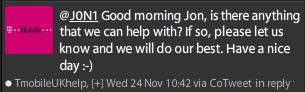
First to react was T-Mobile.

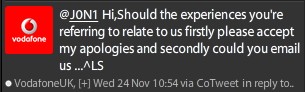
Swiftly followed by Vodafone.

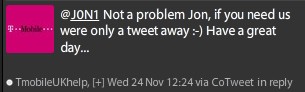
I responded to both, which prompted the following responses.

These interactions helped. They did not solve anything as I had to do that myself. But they did take away my anger and went some way to restoring my faith in humanity (or something like that). Not sure what happened to O2; they either missed my cry for help or decided not to play.

It matters not. I’m no longer on the cusp of leaving my current mobile phone provider.

And in the unlikely event that I do in the near future, it will be Vodafone that get the call.

When is an iPhone not an iPhone?

I find myself on the cusp of leaving my current mobile phone provider.

Not because I can get a better deal elsewhere. And not because their competitors offer better handsets or have erected more masts.

Let’s face it, an iPhone is an iPhone, a Blackberry is a Blackberry and a signal is a signal. Does it really matter which company you choose to provide yours? OK, so price can be a differentiator, but fierce competition means narrow pricing spreads. Which is nice.

For me the real differentiator is customer service.

On two separate occasions recently, one over the phone and the other in the flesh, my current mobile telecoms provider has stretched my patience to the limit and caused my blood to boil. The crime on both occasions was borne out of nothing more than indifference and laziness.

I’m not usually this tolerant. A single piss-poor customer experience is usually enough to push me into the outstretched arms of a competitor; something I have done twice in recent years, once with my digital TV provider and once with my mobile phone provider. That said, I’m normally a very loyal customer. Ask First Direct; I’ve been with them for 22 years and I still love them because of their exceptional telephone operators.

On this occasion it’s going to be a question of 3 strikes and you’re out, because in fairness up until a month ago they had been pretty damned good. But given that 3 out of the 4 mobile contracts in my household are with them, I’d say they are in a state of high risk.

I thought I’d try a little experiment. I’ve read quite a bit about how enlightened companies are using Twitter as an additional customer services channel by intercepting negative sentiment and proactively engaging with unhappy customers and turning them from public detractors to advocates. I even wrote about it myself back in April.

I thought I’d try my current mobile provider out. I’m going to give them a chance to redeem themselves by identifying me as a seriously pissed of customer and go some way to restoring my faith in them by showing some interest and offering me some assistance if appropriate.

Instead of complaining openly on Twitter in the traditional manner I’m going to try something a bit different. Through a few deliberately provocative tweets I’m going to give them the chance to identify me as their customer without me actually telling them that I am.

I’m hoping one or more of my tweets will lead them back to this page, where they can read that they have my explicit permission to call me, DM me or email me to discuss the reasons why I am so upset with them.

If they manage to do this I will not publish details of the two very shoddy customer experiences they have recently forced me to endure.

In order to narrow the field, I will merely say that O2, Vodafone, T-Mobile or Orange – it could be you…


I’m not Spartacus

There was something really quite exciting about seeing the deluge of support sweep across the twitterverse in real-time this morning. In a humbling display of defiance and solidarity, twittizens across the world ignited and united in support of one of their own, falsely accused and wrongly convicted.

His crime was to tweet 109 characters that went on to be interpreted by the judiciary as a menacing threat to blow up an airport: “Crap! Robin Hood airport is closed. You’ve got a week and a bit to get your shit together otherwise I’m blowing the airport sky high!” were the words he apparently wrote to a woman he was due to visit by plane from an airport closed by excessive snowfall.

So on the one hand I find myself rather impressed by the #IAmSpartacus campaign. It resulted in thousands of tweets replaying the offending message. It led to a pledge from the King of Twitter Mr Stephen Fry to pay the fine and associated court costs. It led to 360 news pieces on Google so far today…

On the other hand I chose not to join in all the fun and frolics because I do think that @pauljchambers was a touch foolish to tweet the words ‘airport’ and ‘blowing sky high’ in the same breath (as it were).

I’m sorry but was a bit silly.

But since when has being a bit silly become a criminal offence?

Anyone can see that there was no intent to cause alarm nor to be threatening in any way. In his own mind and in the mind of any right minded person, he was just engaging in a bit of harmless banter and bravado.

None of the pre-requisites of a proper bomb threat were in evidence. No contact with the airport. No intended victim. No attempt to hide his identity. No muffled phone call. No coded message. No known terrorist affiliations. No innocent bystanders at risk.

It looks like the police weren’t sure what they were dealing with. “I had to explain Twitter to them in its entirety because they’d never heard of it” @pauljchambers later told the Telegraph.

The real crime here was the blindingly obvious lack of understanding and common sense from the bench. The judge described the tweet in question as “menacing in its content and obviously so. It could not be more clear. Any ordinary person reading this would see it in that way and be alarmed.”

I think not. That’s just crazy talk…

Permission to send

Make no mistake about it, I do not consider employee communications sent by email SPAM. My definition of SPAM would include the words ‘bulk’, ‘unwanted’, ‘unsolicited’ and ‘indiscriminate’.

Even the most cynical and jaded employee could never accuse employee communications as being indiscriminate. By definition ‘bulk’ would apply as any broadcast employee communications are likely to be sent one-to-many. On the ‘unsolicited’ side, as an employee it would be pretty hard to argue that the company does not have a right and perhaps even a legal obligation to inform you of certain things relating to the work they are paying you for.

That leaves us with ‘unwanted’, which is where I think this discussion needs to focus. This is the basis of permission marketing. Why waste time sending messages to an unreceptive audience? A loyal and enthusiastic customer is likely to elect to receive marketing messages from their favourite brands providing they don’t overdo it. Similarly, a highly engaged employee is more likely to read an email from their CEO than one who has switched off from the company they work for.

So it is a constant challenge for Internal Communicators is to assess the penetration of their company’s broadcast emails.

My experience suggests that very few companies use email management systems/providers such as Vertical Response or dotMailer for their internal audiences. If they did this would be a pointless debate as all the metrics you’d need would be at your fingertips. Come to think of it, why not use these products for Internal Communications? Let’s leave that question for another day!

Most companies use enterprise email clients like Outlook. Yes you can see how many of your emails are never opened if you wish to deploy the read/unread request for every message you send out, but this doesn’t prove much and it annoys the hell out of email recipients. Yes you can survey staff or seek feedback through focus groups – but you can’t do that too often, so the granularity in detail you need will more than likely be missing.

There are many reasons why staff may chose not to read a broadcast email. Not seen as relevant, too long and wordy, annoying frequency, too busy, lost in all the noise, bad past experience etc. Without good feedback mechanisms we’ll never really know.

So why not stick an unsubscribe button on every Internal Communications broadcast email? On a message by message basis you will get instant feedback on the readers’ reaction to the email, measured by the number of unsubscribe requests.

You could then use this data to go back to the requestor on a one-to-one basis and seek feedback which could contribute to you changing the timing, frequency, content, and tone of future emails to improve their effectiveness. You could also use it as an opportunity to seek to change their mind about unsubscribing.

Ideally someone who has actually tried this could share their experience here. Is this something you have already considered and may try out in the future? Do you think your staff would be brave enough to hit the unsubscribe button?