Communication builds trust

Tony Hsieh is the kind of boss everyone wants. Since I first wrote about him in March 2010 I have followed his career with interest and I am a huge fan of his people-focused approach to running a business. The story of Zappos is the ultimate story of how corporate culture can drive commercial success.

Core value number 6 on a T shirtAt the heart of Zappos lie ten core values:

  1. Deliver WOW Through Service
  2. Embrace and Drive Change
  3. Create Fun and A Little Weirdness
  4. Be Adventurous, Creative, and Open-Minded
  5. Pursue Growth and Learning
  6. Build Open and Honest Relationships With Communication
  7. Build a Positive Team and Family Spirit
  8. Do More With Less
  9. Be Passionate and Determined
  10. Be Humble

As an Internal Communicator, number six is obviously my favourite. Zappos believe that open, honest communication is the best foundation for any relationship. They even put it on a T shirt.

They don’t need to spell out if they mean internal or external communications, because for Zappos they are one and the same. Zappos employee communications are conducted in public, in full view of their customers and fans.

On 6 June 2012 Tony Hsieh sent an email to Zappos staff about a very significant corporate development. At the same time he sent a link to the email to his 2.4m followers on Twitter and posted it on http://www.zappos.com.

Most companies sending this kind of all-staff email hit the send button and sit back, hold their breath and wait for a disgruntled employee to leak it to the press. Not Zappos.

It’s an interesting email. Not just because it demonstrates Zappos fusion of internal and external communications. It also contains some lovely pointers towards a corporate culture that has become legendary in employee engagement circles and shows that none of the lustre has been lost by the constraints of plc ownership since Amazon paid $1.1bn for the company in 2009.

I love the fact that Zappos don’t call their Executive Management Team “EMT”, “SMT”, or “ExCo”. No, Zappos call it FACT, after Fred ‘no title’ Mossler , Arun Rajan (CTO), Chris Nielsen (COO & CFO), and Tony Hsieh (CEO – he’s the one with “Zappos” tattooed on his head).

Plc’s have to be very careful about making foward-looking statements outside of the regulatory financial reporting regime. Most companies opt for an easy life and keep schtum. Zappos “create fun and a little weirdness” (core value 3) to ensure their staff get the picture:

As many of you know, we already are operating two physical warehouse buildings and will soon be out of room in those buildings due to our growth. As we started looking into the possibility of opening up a third warehouse building in Kentucky to hold our inventory, we realized that Amazon was already running 69 warehouses around the world. I’ve been *reminded* by our lawyers that I’m not allowed to make forward-looking statements because Amazon is a publicly traded company, so let me phrase things this way: In the next 10 years, if Amazon continues its rapid growth rate, they will be running over 69 gazillion warehouses across the entire universe.”

Despite being CEO of the world’s largest online shoe retailer, I don’t believe Tony Hsieh sees himself as a shoe seller. I think he sees his job as the architect and curator of a unique company culture. A culture where employee empowerment and happiness creates a very powerful virtuous circle where happy staff equals happy customers and happy customers equals even happier staff. And on it goes, leaving investors, shareholders, founders and owners very happy bunnies.

Tony Hsieh is the kind of boss everyone wants. Tony Hsieh is also the kind of boss every shareholder wants.

There’s value in values

What’s the difference between brand values and core values?

Brand values are owned by the brand musketeers in Marketing, often with enthusiastic kettling from ludicrously expensive external consultants. Their job is to communicate to the external audience in a way that creates an expectation of a particular experience with a product or service. They are therefore likely to be aspirational and even on occasion (shock horror) a little bit contrived.  They’re there to sell. They are therefore prone to change and re-invention as new products and services are developed and existing products wither and die.

Core values on the other hand are more likely to belong in the HR stable, often with enthusiastic kettling from ludicrously expensive external consultants. They are directed at the internal audience. They serve as a set of guiding principles to employees. They are enduring truths about what is important to the people within the organisation. They are not objectives. They do not seek to change behaviour. They cannot be invented. They already exist in every organisation. You don’t create them, you uncover them. The essence of core values is that regardless of any changes in your products, services, and the world around you, they remain constant and resonate with everyone in the company.

Forget everything I just said about the above distinction because I don’t believe it really exists – and if it does at your place, sort it out now because it won’t be doing you any favours.

Brand values and core values should be the same thing. Granted, they may need dressing up in slightly different clothing, given that the external and internal audiences will be looking at them from different angles. Regardless, they should be the same thing.

Externally, customers will be looking to see what they can expect when they buy stuff from you or do business with your company. Internally, this message cannot afford to be a promise; it needs to be a deeply held and enduring truth. There has to be full alignment because any disconnect is likely to result in customer disappointment.

Core values that are not deeply held and enduring truths are empty promises.

Core values that are empty promises will not amount to engaged staff.

Brand values that are empty promises will not amount to engaged customers.

Brand values that misalign with core values will lead to internal friction and a lack of engagement with either the brand values or the direction of the company. Staff will question the development of products and services they feel are not aligned with the company’s core values. At best they will become reluctant passengers. They may still travel with you but you will lose their best work and natural advocacy. At worst they will seek every opportunity to apply the brakes.

Whichever way you cut it, customer disappointment is inevitable.

If your brand values are driven by the success of a single product, they will have a shelf life limited to the success of that product. If your brand values are driven by your core values they will have longevity and a dramatic impact on your future product development pipeline and organisational growth.

Take a few minutes to listen to what Steve Jobs had to say on the value of values way back in 1997.

He knew the score.

Customer Service Shocker

Last Friday I ordered a printed T shirt online from www.garmentprinting.co.uk

I have encountered poor customer service before – I’m sure we all have. But have you ever seen a company willing to record such a shocking attitude towards their customer in writing?

My experience when ordering a printed T Shirt online last week surely takes the biscuit.

First an email chronology to set the scene:

11:04 – my online request for a quote is acknowledged
11:09 – confirmation that same day service can be achieved
11:38 – quote received
11:57 – order acknowledged and invoice for “Printing x 1 GD31 – Mens Polo Shirt” received
12:33 – link to approve design & artwork received
12:40 – acknowledgement of my approval received
12:54 – email received providing details of where and when to collect my order

All very good up until this point. Then things took a turn for the worse.

Enter Garment Printing’s Gavin Drake (@garmentprinting on Twitter).


From: Jon Weedon
Date: Fri, Jul 1, 2011 at 1:12 PM
Subject: Re: Garment Printing – Visual Proof – Jon Weedon – Order Ref: GP 5262
To: Garment Printing <sales.team@garmentprinting.co.uk>

Hi there

I just noticed from the visual this is a crew neck. I’m sure I ordered a polo! Is it too late to change?

Jon

Sent from my iPhone


From: Garment Printing – Sales Team <sales.team@garmentprinting.co.uk>
Date: Fri, Jul 1, 2011 at 1:21 PM
Subject: Re: Garment Printing – Visual Proof – Jon Weedon – Order Ref: GP 5262
To: Jon Weedon

I stated that we only has the ability to do tshirts in the quote and in the emails

Thats all we can do, so sorry you missed this bit of info and yes its already gone to process and print

Sorry

Gavin Drake
Garment Printing
http://www.garmentprinting.co.uk
A “Print This Print That” Company


From: Jon Weedon
Date: Fri, Jul 1, 2011 at 2:20 PM
Subject: Re: Garment Printing – Visual Proof – Jon Weedon – Order Ref: GP 5262
To: Garment Printing – Sales Team <sales.team@garmentprinting.co.uk>

No worries I missed that as I’m on my iPhone. All good,

Jon

Sent from my iPhone


From: Jon Weedon
Date: Fri, Jul 1, 2011 at 2:51 PM
Subject: Re: Garment Printing – Visual Proof – Jon Weedon – Order Ref: GP 5262
To: Garment Printing – Sales Team <sales.team@garmentprinting.co.uk>

Hi Gavin

Now that I’m back at my PC I have checked all of the emails including the quote and cannot see any mention of T shirt versus Polo. Am I missing something?

Jon


From: Garment Printing – Sales Team <sales.team@garmentprinting.co.uk>
Date: Fri, Jul 1, 2011 at 2:54 PM
Subject: Re: Garment Printing – Visual Proof – Jon Weedon – Order Ref: GP 5262
To: Jon Weedon

look at original quote

Gavin Drake
Garment Printing
http://www.garmentprinting.co.uk
A “Print This Print That” Company


From: Garment Printing <sales.team@garmentprinting.co.uk>
Date: Fri, Jul 1, 2011 at 2:56 PM
Subject: Garment Printing – Jon Weedon – Ref: GP 5262�
To: Jon Weedon

I sent you this at the very beginning before any quote

Hello Jon Weedon,

We can supply a tshirt today, printed in our Kingston Print House

Can you collect from there.

Otherwise its £20 for the top + same day delivery

Many thanks,

Garment Printing
www.garmentprinting.co.uk


From: Jon Weedon
Date: Fri, Jul 1, 2011 at 3:38 PM
Subject: Re: Garment Printing – Jon Weedon – Ref: GP 5262�
To: Garment Printing <sales.team@garmentprinting.co.uk>

Ah I see. Very subtle! Not exactly “I stated that we only has the ability to do tshirts in the quote and in the emails” is it?

May I suggest next time you spell it out with a bit more clarity rather than seeking to blame your customers for missing the info.

Anyway, thanks for getting this done so quickly.

Jon


From: Garment Printing – Sales Team <sales.team@garmentprinting.co.uk>
Date: Fri, Jul 1, 2011 at 3:42
Subject: Re: Garment Printing – Jon Weedon – Ref: GP 5262�
To: Jon Weedon

OK

look at your quote.

its says £25 (black tshirt)

I think it was clear and thanks for your feedback

Gavin Drake

Garment Printing
http://www.garmentprinting.co.uk
A “Print This Print That” Company


From: Jon Weedon
Date: Fri, Jul 1, 2011 at 4:08 PM
Subject: Re: Garment Printing – Jon Weedon – Ref: GP 5262�
To: Garment Printing – Sales Team <sales.team@garmentprinting.co.uk>

You are missing the point here.

A t shirt to most people is a generic term that could include a crew neck, V neck, polo whatever. I’m not really interested in whether you think your communication was clear – the fact that as a customer I am saying it was not clear should be all you need to concern yourself with so you can avoid future misunderstandings.

Anyway, your attitude alone is such that I will not be using your services again.

Shame because I am genuinely happy with everything else you guys have done for me today.

Regards,

Jon


From: Garment Printing – Sales Team <sales.team@garmentprinting.co.uk>
Date: Fri, Jul 1, 2011 at 4:15 PM
Subject: Re: Garment Printing – Jon Weedon – Ref: GP 5262�
To: Jon Weedon

are you having a bad day?

Gavin Drake
Garment Printing
http://www.garmentprinting.co.uk
A “Print This Print That” Company


From: Jon Weedon
Date: Fri, Jul 1, 2011 at 5:09 PM
Subject: Re: Garment Printing – Jon Weedon – Ref: GP 5262�
To: Garment Printing – Sales Team <sales.team@garmentprinting.co.uk>

Yes actually. Got to Mark’s and the T shirt was not ready. Have to go back in half an hour. Still, no doubt that does not warrant an apology either.

All the best,

Jon


By the time I got back from my second visit to Garment Printing’s local agent I guess Gavin had gone home for the weekend as the communication ceased.

“are you having a bad day?” – can you believe that?

A Lesson in Customer Service

I have a bit of a thing about customer service. For me it is the be all and end all of business success. Poor customer service can kill a killer product and great customer service can flatter a flat product.

Mr Whiteley

I experienced some sublime customer experience the other day from an unexpected source. You don’t often associate customer service with a school. My eldest daughter’s Business Studies teacher changed all that for me. Last Saturday he demonstrated his unquestionable right to teach Business Studies. Not because he is an excellent teacher or because he has the relevant academic qualifications, but because he gets customer service.

Jessica had a hard week last week. She struggled with a couple of mock Business Studies AS Level exams, despite her teacher’s best endeavours in recent weeks to support her with extra tuition sessions during his lunch breaks. She managed 50% in paper 1 and felt that her performance in paper 2 (which had not yet been marked) was worse. There were tears of disappointment and frustration. Bless her, she tries so hard, but sadly endeavour does not always translate into achievement. With the real exams just two weeks away, we were all resigned to a tough weekend ahead.

And then I bumped into her teacher during an open day at the school on Saturday morning and we got talking. He was very receptive, positive and above all, caring. He said some lovely things about my daughter, in particular about her desire to learn and participate in class.

He had not yet marked the 2nd paper so was unable to comment on Jessica’s specific fears about her poor performance at the time. He showed me a list of older pupils that had faced similar difficulties with the subject at the same stage, who had subsequently gone on to attain the required grades to attend their preferred universities. By the time we had finished I was touched and reassured in equal measure.

When I returned home less than an hour later I found an email from him in my inbox stating that he had just marked the second paper and he wanted us to know that Jessica had done better than expected. He wanted us to know so that the anticipated dark cloud hanging over our weekend could be somewhat lifted.

His actions, before, during and after our chance meeting show me he is a dedicated and very engaged employee. His personal and professional pride makes him a seriously valuable asset to the school. It is precisely behaviour that like this that will attract unsolicited recommendation and advocacy from pupils and parents alike. Not to mention ensuring that his pupils achieve the best they could possibly hope for in their exams.

Mr Whiteley I salute you. I am very grateful for the care, support and encouragement you give our daughter.

Tackling social media

A lot of companies misuse and abuse social media. They know they have to do something. They’ve been to one of those crazy overpriced social media conferences and talked to a few agencies and vendors. They keep reading scary stories about it in the papers. They are exposed to the risk of last mover disadvantage and they know it.

So they jump in to tackle social media with both feet off the ground and their studs showing.  Little wonder their customers show them the red card.

So where did they go wrong?

They invited a bunch of senior bods from the Communications, PR, Advertising and Marketing teams to form a squad.  All good people – top performers and experts in their chosen fields – after all, this is important stuff.

The only problem is none of them were active users of social media.

And so they kicked off by applying tried and tested old world communications values to a medium they didn’t really get. They applied military style planning to detailed and time bound communications campaigns. Not realising that command and control does not work in the world of social media, the downward spiral of selling and spamming began.

All they had to do was leverage the existing expertise and enthusiasm of the growing band of natural born social mediarites already on the payroll. The people who understand that social media is not a broadcast channel but a place where people converse and create meaningful relationships.

They should have listened to self-styled Community Evangelist at LinkedIn, Mario Sundar, who made the following observation two years ago:

“Your employees, starting with your executives, influence your company’s employment brand more than any advertising campaign that you will ever craft. They do so through their blog, word-of-mouth sites like Twitter, and of course on LinkedIn, where they build their “professional brand” in ways that are intrinsically tied to your company’s brand.”

They do this through natural authentic daily interactions with their personal and professional networks. They don’t sell. They don’t spam. They don’t follow orders. You cannot script them. All you need to do is allow them the freedom to express themselves and allow their natural advocacy to shine through.

These are the people who should be involved in formulating and delivering your company’s social media strategy.

Good news and bad news

It’s 9am on Monday morning. The telephone is ringing.

Ring ring. Ring ring. Ring ring.

“Jon Weedon”.

“Hi Jon, its James. Have you got a minute?”

“Sure – what’s up?”

“I see there is a link to the Guardian piece on the intranet this morning. Do you really think we should be encouraging staff to read stuff like that? They’ve clearly got it in for us.”

“I agree it’s not the most flattering of pieces. But is in the Guardian. I don’t think we should ignore it just because it doesn’t share our own view of the industry.”

“I’m not saying we ignore it, I just don’t think we should be encouraging staff to read it.”

“Actually it popped up on Google alerts last night. Lots of staff use Google alerts. I guess a fair few also read the Guardian. One thing is for sure, lots of our customers will be reading this today – on and offline. Surely if our customers are reading it, then our staff should at least be aware of it?”

“Yes but it’s full of factual errors and some outrageously biased opinion.”

“Staff aren’t stupid. Just because they read something in the press doesn’t mean they believe it. One thing is for sure though, if we deliberately filter out the bad news and only provide links to the good news, they will quickly realise that the intranet cannot be trusted as a source of news about the company. That discredits the comms team as well as the exec.”

“Well if staff believe half of what the Guardian wrote today that would definitely discredit us.”

“That’s precisely my point. They are more likely to believe it if they don’t trust our internal communications. They will be very unforgiving if they feel they are being deliberately kept in the dark. We should actually look upon a story like this as an opportunity to create discussion internally and help staff understand what the Guardian journo clearly doesn’t”.

“Actually, that’s not a bad idea. Maybe I should write something in the comment section outlining why I believe the newspaper has got it so wrong.”

“That’s a great idea. Maybe you could get Bob to write a few words from the Legal team’s perspective as well…”

“Steady, let’s not get too carried away. I’ll have a word with him and see what he says.”

“I think that would really be appreciated by staff. Can I take it that you are happy for the Guardian piece to remain on the Intranet then”.

“Um. Yes, I guess so.”

So this is not an actual transcript of a recent conversation I hasten to add!

I merely use this technique to illustrate an issue that I have encountered several times over the years – an issue which I suspect internal comms people and intranet managers everywhere have experienced at least once in every company they have ever worked for. That is, a perception among one or more senior executives that internal communications is just about pushing good news around the company.

Of course we should celebrate success at every opportunity. But we should be big enough and brave enough to acknowledge criticism and even failure.

Because for any internal communication to have value, it must first of all be honest.

When is a Blackberry not a Blackberry?

I’m no longer on the cusp of leaving my current mobile phone provider. I’m feeling much better than yesterday thank you very much. Two things have helped.

One is simply the cathartic effect of writing.

The other is the reaction the ‘deliberately provocative tweets’ I published as promised. It only took two tweets. The first one was too late at night to be picked up.

The second one did better.

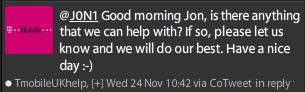
First to react was T-Mobile.

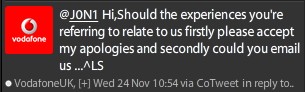
Swiftly followed by Vodafone.

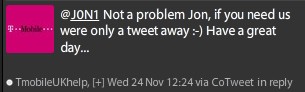
I responded to both, which prompted the following responses.

These interactions helped. They did not solve anything as I had to do that myself. But they did take away my anger and went some way to restoring my faith in humanity (or something like that). Not sure what happened to O2; they either missed my cry for help or decided not to play.

It matters not. I’m no longer on the cusp of leaving my current mobile phone provider.

And in the unlikely event that I do in the near future, it will be Vodafone that get the call.

When is an iPhone not an iPhone?

I find myself on the cusp of leaving my current mobile phone provider.

Not because I can get a better deal elsewhere. And not because their competitors offer better handsets or have erected more masts.

Let’s face it, an iPhone is an iPhone, a Blackberry is a Blackberry and a signal is a signal. Does it really matter which company you choose to provide yours? OK, so price can be a differentiator, but fierce competition means narrow pricing spreads. Which is nice.

For me the real differentiator is customer service.

On two separate occasions recently, one over the phone and the other in the flesh, my current mobile telecoms provider has stretched my patience to the limit and caused my blood to boil. The crime on both occasions was borne out of nothing more than indifference and laziness.

I’m not usually this tolerant. A single piss-poor customer experience is usually enough to push me into the outstretched arms of a competitor; something I have done twice in recent years, once with my digital TV provider and once with my mobile phone provider. That said, I’m normally a very loyal customer. Ask First Direct; I’ve been with them for 22 years and I still love them because of their exceptional telephone operators.

On this occasion it’s going to be a question of 3 strikes and you’re out, because in fairness up until a month ago they had been pretty damned good. But given that 3 out of the 4 mobile contracts in my household are with them, I’d say they are in a state of high risk.

I thought I’d try a little experiment. I’ve read quite a bit about how enlightened companies are using Twitter as an additional customer services channel by intercepting negative sentiment and proactively engaging with unhappy customers and turning them from public detractors to advocates. I even wrote about it myself back in April.

I thought I’d try my current mobile provider out. I’m going to give them a chance to redeem themselves by identifying me as a seriously pissed of customer and go some way to restoring my faith in them by showing some interest and offering me some assistance if appropriate.

Instead of complaining openly on Twitter in the traditional manner I’m going to try something a bit different. Through a few deliberately provocative tweets I’m going to give them the chance to identify me as their customer without me actually telling them that I am.

I’m hoping one or more of my tweets will lead them back to this page, where they can read that they have my explicit permission to call me, DM me or email me to discuss the reasons why I am so upset with them.

If they manage to do this I will not publish details of the two very shoddy customer experiences they have recently forced me to endure.

In order to narrow the field, I will merely say that O2, Vodafone, T-Mobile or Orange – it could be you…