Scoffing at Spam

spamI received an interesting unsolicited email this morning from Neil. It caught me off-guard whilst downing my first triple espresso of the day.

It was instantly engaging as it didn’t look like commercial grade spam, which usually gets insta-deleted if the spam filter hasn’t already done its job. It looked like a normal email from someone I knew. Everyone knows at least one Neil right?

It started so well. Lots of white space told my brain even before I got past the nice informal greeting that I was going to read this. The first sentence was perfect. I was hooked. There’s no way I wasn’t going to finish this one.

Hi Jon

When it comes to creating powerful internal communications, we make the complicated very simple.

So we will keep this short.

Line three could have been glorious if Neil had avoided the corporate ‘we’ and simply said “So I will keep this short”. It’s not just me; there’s a few of us out there who find the ‘corporate we’ troublesome.  Anyway, I was still fully on-board at that point.

Then bang. Neil hit the iceberg.

tbp! offer a compelling blend of writing and design expertise that delivers unexpected but relevant creative solutions through all media channels.

Does anyone else see the irony of claiming writing and design expertise, as well as the ability to make ‘complicated very simple’ – and then beginning a sentence with tbp! ?

Try writing it. Those 4 simple characters take 10 keystrokes (and two hands!) to bold, italicize, and underline, before going back to the front of the word to replace the capital ‘T’ with a small “t”.

Please don’t think I’m passing judgment on a bunch of fellow communications professionals that I have never met before. I’m sure they have a long rosta of very satisfied clients and are no doubt great writers and designers.

And I’m not mocking Neil, I merely used his name as it is on the email and it works nicely as a short, uncomplicated literary device in the context of this story.

In fact, to reinforce this point I dropped him a line earlier to let him know I’d be writing this post, and he’s a lovely chap. He even had the decency to spot a typo on my LinkedIn profile, where many years ago I’d erroneously and somewhat ironically written !5 instead of 15.

The final irony is that if the offending tbp! had been replaced with a ‘corporate we’, I’d never have got to write this story, and Neil and I would never have connected.  So maybe after all, that was tbp!’s master plan and I fell for it, hook line and sinker…

Speak from the heart

ImageAndrew Mason, CEO of Groupon was fired yesterday. It’s not difficult to see why. The company’s share price has fallen by 77% since it went public on the NASDAQ in 2011. Not many CEOs can survive such a horror show.

What makes this story so different is the manner in which staff were informed.

Such high level ‘departures’ are normally accompanied by the usual nonsense about leaving ‘by mutual consent in order to pursue other opportunities’. Nobody ever buys the line and yet the PRs still trot it out with alarming regularity.

How refreshing then to see staff being informed by the man himself, clearly in his own words, with an honesty, humility and good humour that serves to make his thank-you to the ‘People of Groupon’ all the more powerful and irresistible.

Here is the text of his email in full. It is worth reading. I can’t remember ever reading such a brilliant piece of leadership communication.

People of Groupon,

After four and a half intense and wonderful years as CEO of Groupon, I’ve decided that I’d like to spend more time with my family. Just kidding – I was fired today. If you’re wondering why … you haven’t been paying attention. From controversial metrics in our S1 to our material weakness to two quarters of missing our own expectations and a stock price that’s hovering around one quarter of our listing price, the events of the last year and a half speak for themselves. As CEO, I am accountable.

You are doing amazing things at Groupon, and you deserve the outside world to give you a second chance. I’m getting in the way of that. A fresh CEO earns you that chance. The board is aligned behind the strategy we’ve shared over the last few months, and I’ve never seen you working together more effectively as a global company – it’s time to give Groupon a relief valve from the public noise.

For those who are concerned about me, please don’t be – I love Groupon, and I’m terribly proud of what we’ve created. I’m OK with having failed at this part of the journey. If Groupon was Battletoads, it would be like I made it all the way to the Terra Tubes without dying on my first ever play through. I am so lucky to have had the opportunity to take the company this far with all of you. I’ll now take some time to decompress (FYI I’m looking for a good fat camp to lose my Groupon 40, if anyone has a suggestion), and then maybe I’ll figure out how to channel this experience into something productive.

If there’s one piece of wisdom that this simple pilgrim would like to impart upon you: have the courage to start with the customer. My biggest regrets are the moments that I let a lack of data override my intuition on what’s best for our customers. This leadership change gives you some breathing room to break bad habits and deliver sustainable customer happiness – don’t waste the opportunity!

I will miss you terribly.

Love,

Andrew
(above text unashamedly stolen from The Guardian)

Before today I knew nothing about Andrew Mason. I now feel I know a lot more than about him and what makes him tick than I could ever have learned from reading 100 stories about him in the business press.

And it seems to me that Groupon’s problems are not the result of poor leadership. As an occasional Grouponite myself, the fundamental business model is the real problem.

After all, there’s only so many cut price spa treatments, manicure sets and restorative scalp gels a man can take.

Good luck Andrew, I have no doubt this is not the last we’ll be seeing of you.

How long have I got?

kittenI have a tendency to be a bit wordy. I love the idiosyncrasies of our beautiful language and enjoy playing with them every time I indulge in a bit of creative writing. I love to use colourful words to paint a picture, dramatic words to hold centre stage, and captivating words to tell a story.

The only problem is I do most of my writing online and online readers have a very short attention span. According to research by Jakob Nielsen, on a typical web page, users have neither the time nor inclination to read more than 20% of the words on show. We skim read online a whole lot more than when we read a book. We like our words to be served up in bite-sized chunks. When Twitter first appeared 140 characters seemed ludicrously slim pickings to most of us and now they feel like a meaty feast.

And that’s always assuming you make it to the page in the first place. Google engineers have discovered that people will visit a web site less often if it is slower than a close competitor’s by more than 250 milliseconds. That’s quicker than the blink of an eye. Tests done at Amazon five years ago revealed that for every 100 milliseconds increase in page load time, sales decrease by 1%. In 2009, Forrester Research found that online shoppers expected pages to load in 2 seconds and at three seconds, a large share abandon the site.

Clearly we digital natives are an impatient bunch.

That’s why the single most important rule I subscribe to when writing at work is “If in doubt, take it out”.

We must respect people’s time by making sure our communications are relevant, timely and above all concise.

RIP email. Is the writing on the Wall?

“I hate to be the bearer of bad news, but in consumer technology, if you want to know what people like us will do tomorrow, you look at what teenagers are doing today. And the latest figures say that only 11% of teenagers email daily. So email – I can’t imagine life without it – is probably going away”

Facebook COO Sheryl Sandberg made this bold prediction in 2009. She’s not alone. Experts have been predicting the demise of email for years.

I must confess, until my flirtation with Twitter and LinkedIn turned into a full-on love affair I remained sceptical about such claims, such was my appreciation of and dependence on email in and out of work.

Today, I’m afraid email has lost its sparkle. It has become nothing more than a tedious, ponderous and bloated utility. My use is pretty much confined to business, where it remains ubiquitous and, for the foreseeable future, will remain so until someone comes up with a better dashboard for managing ones private business communications, tasks and appointments.

The communication element of email at work for many of us has largely been usurped by Instant Messaging. Email tends to get used when speed is not important, the person I wish to communicate is not immediately available, or I want to keep an easily accessible record of a request or response. Outside of work I have stopped using it other than where someone else requires or expects an email from me.

Some social mavericks have made public declarations of their intention to work without email. Professor Paul Jones now expects his colleagues and students to use other means to contact him. IBM staffer Luis Suarez has lived and worked for the last 3 years without email. Good for them – not so good perhaps for some their colleagues who are forced to use unfamiliar and unwelcome technologies if they wish to make contact.

Going back to Sheryl Sandberg, what she describes is life before work. Teenagers don’t need all that work stuff. What they want is instant communication gratification. Email is too slow. It doesn’t match up to their social intensity. Blackberry Messenger has given Blackberry a new lease of life and a whole new generation to sell to. Who’d have thought Blackberry would produce a TV ad aimed at teenagers a few years ago? My kids don’t want an iPhone because bbm is so highly valued among their age group.

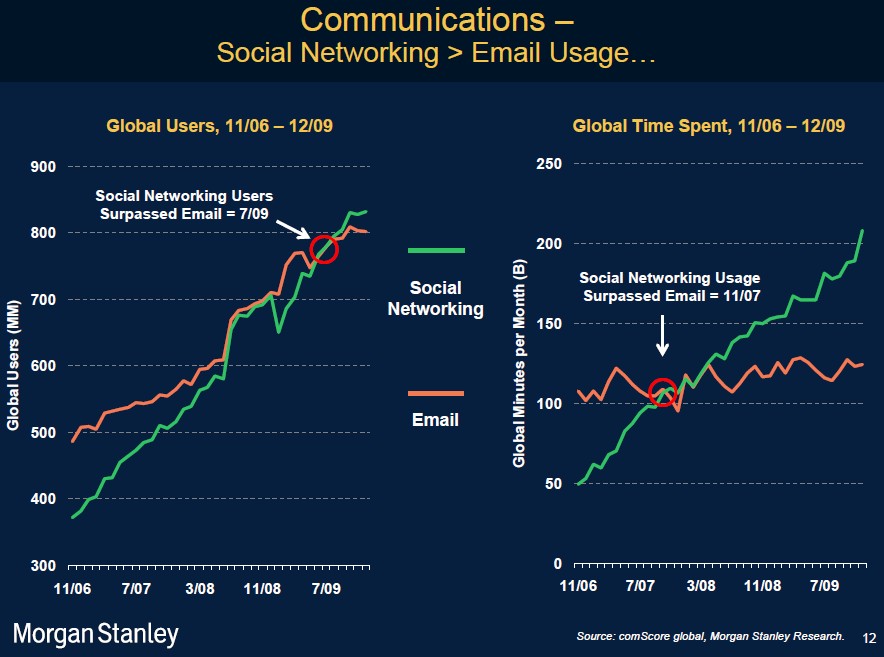
This graph from Morgan Stanley’s 2010 Internet Trends report shows that in July 2009, social media users overtook email users across the globe for the first time and I bet that the gap will have grown significantly by the time their next report is published.

One thing that will keep email figures artificially high is that all of the emergent social media channels use email to drive traffic to their sites. Around 85% of my own private emails are Twitter, LinkedIn or Empire Avenue activity notifications.

By the time I read them I have already seen the details on the sites themselves, which present the information in a far more digestible and accessible way, which is why my private email inbox tends to be my last port of call when I go online every day.

My main activity within my private email account seems to be deleting pages and pages of unread, unwanted and unimportant emails.

What do you think? Do you think email will survive in its current form?