Next practice not best practice

‘Best Practice’ is one of those buzzwords that gets chucked around corporations with impunity. I get where it’s come from and I get why many like to rely on it – I mean, once you have found a way to do something successfully, why would you not want to replicate that experience over and over again?

Here’s why. The speed of change in human behaviour brought about by the speed of change in technology means that by the time something becomes enshrined as best practice, it is already likely to have been superseded. That’s because for the first time since the written word arrived, we are no longer masters of the message or the medium.

dinosleep2Best practice should no longer be seen as a blueprint for describing the standard way of doing things in an organisation. It’s too safe. It’s too comfortable. And it’s too predictable. I see evidence all over the place, especially in advertising, marketing and PR. If you’re going to cite best practice as your primary justification for doing things in a certain way, you may as well stick a sign above your desk while you’re at it saying “Quiet please, dinosaur sleeping”.

We need to think differently; with agility, fluidity, creativity and a bit more bravery. Best practise has served us well for decades, nay centuries – because we have been able to control the messages and the medium. We are losing this power with every day that passes. Carrier pigeons, telegrams, snail mail, faxes, email – same difference really – all had similar limitations when it came to reach, speed and spread. Social Media has democratised communication like never before and it’s turned us all into authors and broadcasters.

It’s time to forget about best practise. The pace of change is such that predicting ‘next practice’ is what will bring the bacon home.

Speak from the heart

ImageAndrew Mason, CEO of Groupon was fired yesterday. It’s not difficult to see why. The company’s share price has fallen by 77% since it went public on the NASDAQ in 2011. Not many CEOs can survive such a horror show.

What makes this story so different is the manner in which staff were informed.

Such high level ‘departures’ are normally accompanied by the usual nonsense about leaving ‘by mutual consent in order to pursue other opportunities’. Nobody ever buys the line and yet the PRs still trot it out with alarming regularity.

How refreshing then to see staff being informed by the man himself, clearly in his own words, with an honesty, humility and good humour that serves to make his thank-you to the ‘People of Groupon’ all the more powerful and irresistible.

Here is the text of his email in full. It is worth reading. I can’t remember ever reading such a brilliant piece of leadership communication.

People of Groupon,

After four and a half intense and wonderful years as CEO of Groupon, I’ve decided that I’d like to spend more time with my family. Just kidding – I was fired today. If you’re wondering why … you haven’t been paying attention. From controversial metrics in our S1 to our material weakness to two quarters of missing our own expectations and a stock price that’s hovering around one quarter of our listing price, the events of the last year and a half speak for themselves. As CEO, I am accountable.

You are doing amazing things at Groupon, and you deserve the outside world to give you a second chance. I’m getting in the way of that. A fresh CEO earns you that chance. The board is aligned behind the strategy we’ve shared over the last few months, and I’ve never seen you working together more effectively as a global company – it’s time to give Groupon a relief valve from the public noise.

For those who are concerned about me, please don’t be – I love Groupon, and I’m terribly proud of what we’ve created. I’m OK with having failed at this part of the journey. If Groupon was Battletoads, it would be like I made it all the way to the Terra Tubes without dying on my first ever play through. I am so lucky to have had the opportunity to take the company this far with all of you. I’ll now take some time to decompress (FYI I’m looking for a good fat camp to lose my Groupon 40, if anyone has a suggestion), and then maybe I’ll figure out how to channel this experience into something productive.

If there’s one piece of wisdom that this simple pilgrim would like to impart upon you: have the courage to start with the customer. My biggest regrets are the moments that I let a lack of data override my intuition on what’s best for our customers. This leadership change gives you some breathing room to break bad habits and deliver sustainable customer happiness – don’t waste the opportunity!

I will miss you terribly.

Love,

Andrew
(above text unashamedly stolen from The Guardian)

Before today I knew nothing about Andrew Mason. I now feel I know a lot more than about him and what makes him tick than I could ever have learned from reading 100 stories about him in the business press.

And it seems to me that Groupon’s problems are not the result of poor leadership. As an occasional Grouponite myself, the fundamental business model is the real problem.

After all, there’s only so many cut price spa treatments, manicure sets and restorative scalp gels a man can take.

Good luck Andrew, I have no doubt this is not the last we’ll be seeing of you.

Reflections on grief

In 2003, Detective Constable Stephen Oake was stabbed to death as he carried out an immigration raid in Manchester. His killer was arrested at the scene and subsequently locked up for life. One of the remarkable aspects of this tragedy was the incredibly dignified way his father dealt with the loss of his only son.

When ex Isle of Man Chief Constable Robin Oake faced journalists at the press conference following the murder, he was asked what he felt about the man who killed his son. His reply took everyone by surprise: “I don’t know the man or the circumstances but from my heart I forgive him.”  Mr Oake later went on to write a book called Father Forgive: The Forgotten ‘F’ Word

I knew nothing of this until I heard Mr Oake being interviewed on the Radio last week in connection with the killing of two police officers in Manchester the previous day. I was struck by his measured tone and dignity as he empathised with the families of the two murdered women. He spoke of the difficult journey ahead and the importance of forgiveness as part of the healing process.

ImageIn stark contrast, a week earlier the Hillsborough report was published and our newspapers and TV screens were dominated by stories of cover-up, culpability and injustice. One recurring sentiment expressed by friends and families of some of the 96 people who lost their lives 23 years ago was the need for justice.

They wanted those they considered responsible for the deaths of their loved ones to be brought to book. Not a single word was uttered about forgiveness.

So how is it that a man can pray for the killer of his only son and forgive him even before he’s been convicted, while hundreds of grieving relatives almost a quarter of a century on cannot see past blame and retribution?

It’s because the relatives of the 96 were denied the opportunity for closure due to misinformation, cover-up and not being listened to. They have never had the opportunity to forgive because instead of embarking on a search for the truth, those in positions of high power sought to evade any sense of personal or collective responsibility.

The irony is I don’t believe justice will ever be done. What happened at Hillsborough on 15 April 1989 was the crashing together of a series of errors in human judgment that each in isolation would in all likelihood have been inconsequential. Decisions made by the FA, Sheffield United FC, stewards, police, the ambulance service and yes, dare I say it, some of the fans, all collided that day in a way that nobody could possibly have predicted.

There was nobody left holding a bloodstained knife. Nobody standing there with a smoking gun. No tangible killer to blame. The misinformation that followed and the desire by certain people to exonerate themselves rather than accept their contribution to the series of events that resulted in catastrophic loss of life is the real crime here.

I’m not sure if there is a communications lesson here or not.

There is most certainly evidence of the devastating damage to people’s lives that can be caused by those who we all rely on to act with honesty and integrity don’t.

And given the person being held up as the biggest villain of the piece is Kelvin MacKenzie, a lifelong professional communicator who was nowhere near Hillsborough that day, nor could he be held in any way responsible for the chain of events that led up to the tragedy, I think there probably is a communications lesson in here somewhere…

RIP Stephen Oake and the Liverpool 96.

Communication builds trust

Tony Hsieh is the kind of boss everyone wants. Since I first wrote about him in March 2010 I have followed his career with interest and I am a huge fan of his people-focused approach to running a business. The story of Zappos is the ultimate story of how corporate culture can drive commercial success.

Core value number 6 on a T shirtAt the heart of Zappos lie ten core values:

  1. Deliver WOW Through Service
  2. Embrace and Drive Change
  3. Create Fun and A Little Weirdness
  4. Be Adventurous, Creative, and Open-Minded
  5. Pursue Growth and Learning
  6. Build Open and Honest Relationships With Communication
  7. Build a Positive Team and Family Spirit
  8. Do More With Less
  9. Be Passionate and Determined
  10. Be Humble

As an Internal Communicator, number six is obviously my favourite. Zappos believe that open, honest communication is the best foundation for any relationship. They even put it on a T shirt.

They don’t need to spell out if they mean internal or external communications, because for Zappos they are one and the same. Zappos employee communications are conducted in public, in full view of their customers and fans.

On 6 June 2012 Tony Hsieh sent an email to Zappos staff about a very significant corporate development. At the same time he sent a link to the email to his 2.4m followers on Twitter and posted it on http://www.zappos.com.

Most companies sending this kind of all-staff email hit the send button and sit back, hold their breath and wait for a disgruntled employee to leak it to the press. Not Zappos.

It’s an interesting email. Not just because it demonstrates Zappos fusion of internal and external communications. It also contains some lovely pointers towards a corporate culture that has become legendary in employee engagement circles and shows that none of the lustre has been lost by the constraints of plc ownership since Amazon paid $1.1bn for the company in 2009.

I love the fact that Zappos don’t call their Executive Management Team “EMT”, “SMT”, or “ExCo”. No, Zappos call it FACT, after Fred ‘no title’ Mossler , Arun Rajan (CTO), Chris Nielsen (COO & CFO), and Tony Hsieh (CEO – he’s the one with “Zappos” tattooed on his head).

Plc’s have to be very careful about making foward-looking statements outside of the regulatory financial reporting regime. Most companies opt for an easy life and keep schtum. Zappos “create fun and a little weirdness” (core value 3) to ensure their staff get the picture:

As many of you know, we already are operating two physical warehouse buildings and will soon be out of room in those buildings due to our growth. As we started looking into the possibility of opening up a third warehouse building in Kentucky to hold our inventory, we realized that Amazon was already running 69 warehouses around the world. I’ve been *reminded* by our lawyers that I’m not allowed to make forward-looking statements because Amazon is a publicly traded company, so let me phrase things this way: In the next 10 years, if Amazon continues its rapid growth rate, they will be running over 69 gazillion warehouses across the entire universe.”

Despite being CEO of the world’s largest online shoe retailer, I don’t believe Tony Hsieh sees himself as a shoe seller. I think he sees his job as the architect and curator of a unique company culture. A culture where employee empowerment and happiness creates a very powerful virtuous circle where happy staff equals happy customers and happy customers equals even happier staff. And on it goes, leaving investors, shareholders, founders and owners very happy bunnies.

Tony Hsieh is the kind of boss everyone wants. Tony Hsieh is also the kind of boss every shareholder wants.

Puffery

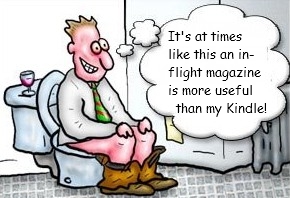
I’m a frequent flyer, and as a consequence of international aviation law and my lily-livered British tendency to comply with silly rules, I tend to browse through the in-flight magazine until the seatbelt sign goes out. I’d love to know the real reason why I am forbidden from reading my Kindle, but that’s another story.

Anyway, that’s why I came across an astonishing example of corporate puffery this evening. You know the stuff. Bland and meaningless tosh used by corporate communicators the world over to fill a bit of space when they have nothing really to say.

Here is the offending piece, which is part of the welcome page inside the front cover, written (well, signed at least) by the airline’s Managing Director:

“With the new year fast approaching, I would like to share with you the news that throughout 2012 we will be announcing a number of new initiatives. These will ensure that we continue to making flying with us the quickest, most comfortable and best-value way to travel across Europe.”

He then moves on, swiftly changing the subject, leaving me in such a state that I felt compelled to  whip out my laptop and write my first ever airborne blog.

Quite how the intention to announce news of news next year can constitute news today is beyond me.

But what is worse – corporate puff or marketing bull?

Freedom of the press

Freedom of the press normally applies to the freedom of the press and media to operate and report without unreasonable state interference. It’s important all right, but not for me today. My mind is weighing heavily on a different interpretation of this much used phrase.

I’m looking at the freedom of the press to ride roughshod over the principles, ethics and standards of journalism. Principles like objectivity, impartiality, fairness and accountability. Principles that every journalist should swear by, but sometimes seem to stick two fingers up at instead.

Yesterday, The Telegraph’s Business Editor Alistair Osborne posted a news story bearing the headline “Betfair a ‘shambles’ says punter who lost £16,000”. With a headline like that it was soon all over Twitter like a rash.

Before I go any further I should declare an interest here. I worked for Betfair for two and a half years up until January 2011. I left the company by choice. I am not a shareholder. Regular readers of my blog will know that I am a long standing Betfair customer and fan of the company. My experience working for Betfair served to reinforce what I have always believed. It is a great business, run my passionate and capable people, as well as a great place to work.

After reading the piece I was left with an uneasy feeling that the author has a bit of an axe to grind. Since when has a customer service issue become bona fide business news in a quality UK broadsheet?  At best it’s the kind of story that given time may possibly develop into something Anne Robinson may take up on Watchdog – but even that is unlikely as there is no question of skulduggery or deceit.

I then noticed that the author’s last two pieces on Betfair were equally critical in content and tone. I had even tweeted about one of them at the time just a few days ago, as I was disappointed to learn that Betfair had physically prevented journalists (including Alistair Osborne evidently) from entering their AGM. My feeling at the time was that adopting a bunker mentality was not sensible for a public company with nothing to hide.

Anyway, after reading the comments under Mr Osborne’s latest piece I was quite shocked at how many people were taking the opportunity to indulge in a spot of Betfair bashing. So I tried to redress the balance and point out that in my opinion the author had an axe to grind and the story was a ‘shameful’ piece of journalism.

Well the moderator was having none of it and after a short delay my comment was removed. Luckily I kept a copy. This is what I posted:

“Shameful journalism. This is not business news. This is the kind of tosh I’d expect from Anne Robinson on Watchdog, not from a business editor on the Telegraph. The author clearly has a personal agenda here. Just look at his recent pieces on Betfair. Take a long hard look at yourself in the mirror Mr Osborne. Is this how they taught you to behave in journo school?”

At the last count the article has 91 comments. Many are littered with strongly worded abuse towards the company, the industry and even the ‘victim’. Some accuse Betfair of being rigged. Others of theft. One even makes reference to the CEO’s ethnicity and jokes about his access to triad gangs to enforce gambling debts.

One wag using the name “the_judge” wrote “Jon Weedon get back in your plantpot. Betfair is a scam outfit. It took me months to get my deposits back from these crooks. I hope they go bust and your shares go down the toilet.”

My point is that my comment was not half as rude or threatening as many posts that still reside in the thread. I can only conclude that it was removed because it did not comply with the sentiment of the anti-Betfair brigade who dominate the thread and it dared to question the author’s journalistic integrity. It looks like the expedient route of censorship prevailed over freedom of speech.

It feels very much to me like double standards are at play here. How can a member of the press corp being excluded from an AGM be an outrage, when a member of the public being excluded from commenting on a poor piece of journalism is fine?

Hurrumph…

Where PR means Pseudo Research

It’s very easy these days to be seduced by facts and figures bombarding those of us who reside in socialmediaville. Infographics, soundbites and statistics proliferate, often sensational and always enticing – and frequently ripped out of recently published “research”.

There’s no doubt about it, “research” creates great PR, both in print and online media.

Whilst writing a piece for Riding the Ripple (as yet unpublished) on the pros and cons of employers blocking access to social media, I kept stumbling across several examples of this. All have been widely reproduced in hundreds of blogs and news aggregators out there, and all have invariably been treated as research and not PR.

Forget about column inches – these reports have generated column miles:

Looking Inside Out: Benchmarking web usage and social media behaviour in the workplace
Commissioned by a company that specialises in web and email filtering and reporting solutions.

Social Media Costing UK Economy up to £14billion in Lost Work Time
Report on the proliferation of employees accessing social media sites at work commissioned by an online recruitment company.

I Can’t Get My Work Done! How Collaboration & Social Tools Drain Productivity
Commissioned by a company that supplies ‘Social email’ software.

I don’t doubt that that this kind of PR research can contain very useful and interesting insights and learnings. And I certainly I don’t question the integrity of the statistics they contain.

I do feel however that we must tread carefully when relying on them as a basis for contributing to an intellectual argument and making robust decisions in business.

Because fundamentally they are a sales tool.

Has anyone come across any other recent examples they would like to share?