Asda’s Green Room re-visited

This time last year I scribbled down a few thoughts on Asda’s Green Room, a website where Asda staff can get together to find out what’s happening around the company as well as share their own stories, pictures and videos.

What makes the Green Room so special is that whilst most companies do this kind of thing, very few do so in public. There’s no hiding behind the corporate firewall here.  Customers, shareholders, media, rivals – in fact anyone with a passing interest in Asda can visit the site and have their say.

So when I heard that the Green Room had a makeover last week I rushed back to pay a visit – and I must say it looks amazing.

The new homepage is very easy on the eye and packed with attractive hooks to draw you deeper into some great content.  Additional functionality has been added to make it easier to submit comments, upload and preview pictures, and receive progress information on both.

New design elements have enhanced navigation around the site as well as point you to other linked resources like the Green Room’s Facebook page and Twitter feed. I really really like what they have done.

I said some pretty negative things last time round about my disappointment at the lack of obvious staff interaction with the site. I’m pleased to say things have improved on that front.

There was a lovely news piece from early December where Asda President and CEO Andy Clarke thanked staff for their Herculean efforts in keeping the business going during the extreme weather conditions, in short informal video. This in turn attracted a bunch of comments from staff and customers, telling their own stories of braving the Arctic conditions.

If I were to be really picky (which obviously I am!) I’d have loved to have seen a follow-up comment from Andy Clarke in the thread acknowledging the stories, in particular the comment from an Asda customer who explains why the residents of Slack Head in Beetham are “very lucky to have one of your employees in our community”. This kind of content is priceless. But only if people are reading it.

There is still a lot of work to be done to make the Green Room the runaway success it deserves to be. Despite improvements, levels of engagement with staff are still patchy. Most of the news stories don’t seem to attract comments, including one where the company announced it had raised £4m last year for partner charity Tickled Pink. Another story about a member of staff who had just won £5.6m on the National Lottery attracted a single solitary comment.

The same lack of engagement is reflected on Facebook, where since the beginning of December, the 30-odd posts on the Green Room wall have attracted just 4 comments.

The next step for the Green Room team has to be off-line.

The on-line offering is more than fit for purpose. It is actually bloody good. What is needed now is awareness, education, and encouragement.  Staff need to be encouraged and empowered to get involved. The easy bit has been done – the hard bit starts now.

The key to success in my opinion will be getting the entire management community to lead by example. They need to demonstrate through their own actions that engaging with the Green Room is not just permitted, but genuinely encouraged.

Turds floating on the sea of life

I got up extra early this morning to get into the office and get a few hours under my belt before belting up North for a funeral.

I never made it into work because some troubled soul decided to bring the West End to its knees by breaking into a shop on Regent Street and when the Old Bill turned up he threatening to blow himself up with what turned out to be a tube of Smarties.  

After several hours of tense stand-off and negotiations the man was nicked. Some eight hours later the last of the police cordons was finally lifted and normality returned to London’s West End. If such a condition exists in London’s West End…

Yep – hundreds, possibly thousands of people never made it to work today because of a lunatic wielding a tube of brightly coloured sugar coated chocolate drops.

Meanwhile I had been to the funeral of TJ.

Four years my junior, TJ was tragically taken from us last month by a sudden and fatal heart condition while travelling in the South Pacific. He was fitter and leaner than every one of his old colleagues and friends who turned up to say farewell today. By rights he should have lived for another 30 years and continue to brighten the lives of those lucky enough to know him.

I then spent 3 hours trying to get back into London because some other troubled soul decided to jump in front of a train in Slough, causing the usual network chaos that accompanies such behaviour.

One life taken far too early from a man that really valued it, versus thousands of lives inconvenienced by the actions of a man who clearly didn’t and another who clearly doesn’t. It just doesn’t seem fair.

Today was a crazy day. It was one of those days where the frailty of the human condition exposed itself in all its glory.

When is a Blackberry not a Blackberry?

I’m no longer on the cusp of leaving my current mobile phone provider. I’m feeling much better than yesterday thank you very much. Two things have helped.

One is simply the cathartic effect of writing.

The other is the reaction the ‘deliberately provocative tweets’ I published as promised. It only took two tweets. The first one was too late at night to be picked up.

The second one did better.

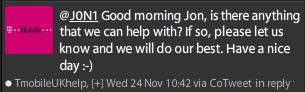
First to react was T-Mobile.

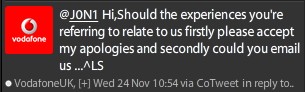
Swiftly followed by Vodafone.

I responded to both, which prompted the following responses.

These interactions helped. They did not solve anything as I had to do that myself. But they did take away my anger and went some way to restoring my faith in humanity (or something like that). Not sure what happened to O2; they either missed my cry for help or decided not to play.

It matters not. I’m no longer on the cusp of leaving my current mobile phone provider.

And in the unlikely event that I do in the near future, it will be Vodafone that get the call.

When is an iPhone not an iPhone?

I find myself on the cusp of leaving my current mobile phone provider.

Not because I can get a better deal elsewhere. And not because their competitors offer better handsets or have erected more masts.

Let’s face it, an iPhone is an iPhone, a Blackberry is a Blackberry and a signal is a signal. Does it really matter which company you choose to provide yours? OK, so price can be a differentiator, but fierce competition means narrow pricing spreads. Which is nice.

For me the real differentiator is customer service.

On two separate occasions recently, one over the phone and the other in the flesh, my current mobile telecoms provider has stretched my patience to the limit and caused my blood to boil. The crime on both occasions was borne out of nothing more than indifference and laziness.

I’m not usually this tolerant. A single piss-poor customer experience is usually enough to push me into the outstretched arms of a competitor; something I have done twice in recent years, once with my digital TV provider and once with my mobile phone provider. That said, I’m normally a very loyal customer. Ask First Direct; I’ve been with them for 22 years and I still love them because of their exceptional telephone operators.

On this occasion it’s going to be a question of 3 strikes and you’re out, because in fairness up until a month ago they had been pretty damned good. But given that 3 out of the 4 mobile contracts in my household are with them, I’d say they are in a state of high risk.

I thought I’d try a little experiment. I’ve read quite a bit about how enlightened companies are using Twitter as an additional customer services channel by intercepting negative sentiment and proactively engaging with unhappy customers and turning them from public detractors to advocates. I even wrote about it myself back in April.

I thought I’d try my current mobile provider out. I’m going to give them a chance to redeem themselves by identifying me as a seriously pissed of customer and go some way to restoring my faith in them by showing some interest and offering me some assistance if appropriate.

Instead of complaining openly on Twitter in the traditional manner I’m going to try something a bit different. Through a few deliberately provocative tweets I’m going to give them the chance to identify me as their customer without me actually telling them that I am.

I’m hoping one or more of my tweets will lead them back to this page, where they can read that they have my explicit permission to call me, DM me or email me to discuss the reasons why I am so upset with them.

If they manage to do this I will not publish details of the two very shoddy customer experiences they have recently forced me to endure.

In order to narrow the field, I will merely say that O2, Vodafone, T-Mobile or Orange – it could be you…

Chugger off!

Figures suggest that on any given weekday around 500 face-to-face charity fundraisers can be found on UK high streets. Affectionately known as chuggers, a word derived from combining ‘charity’ with ‘mugger’, my local high street seems have more than its fair share of the pesky buggers.

I have no issue with the chuggers themselves of course – they’re only trying to earn an honest crust after all. What bothers me more is the charities who employ them.

Research indicates that two-thirds of the Great British public would cross the road to avoid a chugger and that 25 per cent of people actually hate being approached by one.

Assuming that there is some substance to this research, the stark reality is that deploying chuggers cannot be good for a charity’s reputation. Can you imagine any kind of successful commercial entity operating in a way that knowingly alienates more potential customers than it pleases?

The Public Fundraising Regulatory Association (PFRA) takes a very interesting stance on this very issue. In answer to the FAQ do people have a right to walk down the street without being asked to give to charity they state:

“Sorry if we sound a bit blunt, but, do they, actually? We frequently hear versions of this argument… we don’t want to come across as being flippant and dismissive, but we really think the basis of this whole argument requires closer examination. Where does this ‘right’ come from?”

Well yes, this does sound a touch dismissive and pretty complacent actually. Perhaps they should take heed and do something about it rather than pretend it is not a real problem which is affecting the reputations of their members on a daily basis.

The return on investment for charities that chug is around 3 to 1, which I guess to them must seem pretty attractive. But do supporters really want to see a third of their donations lining the pockets of the chuggers rather than go directly to the charity? I know I don’t and personally I think it lacks imagination and is lazy fundraising.

I have a soft spot for charities who choose to communicate and engage with potential supporters directly and in a way that creates a positive and sustainable relationship, especially those who use volunteers and ambassadors to spread the word.

I know it isn’t easy, but I’d like to see a lot more hugging and a lot less chugging.

Marketing bull

There’s nothing like a bit of marketing bullshit to invigorate your day.

You know the kind of stuff I’m on about: “I need a cradle to grave solution pronto – I want you to shoot for the moon but let’s not boil the ocean on this one amigos, we simply don’t have the bandwidth”…

I’m delighted to report that in my relatively short experience with my current employer I don’t see much of this (other than when agencies pop in to pitch for some business and the occasional chai latte).

So imagine my surprise when I received a draft communication recently from one of our own Marketing boys about a new product he wanted to let everyone know about, which contained the following line:

“…as part of our overall drive to dial up the volume button on our value pillar and to make value core to our brand this year across all channels…”

On the whole, the draft was actually a beautifully written piece and got the message across perfectly until this sliding tackle from behind left me with no choice but to reach for the yellow card.

My modest contribution to improving this line was to simplify the text by removing the offending words, leaving:

“…as part of our overall drive to make value core to our brand this year across all channels…”

Hands up anyone who thinks the volume button and value pillar will be missed?

Ninja worrier

Emotional stress is a killer. It is a major contributor to heart disease and other life threatening illnesses. It also causes exhaustion, irritability, angry outbursts, muscular tension and poor concentration levels.

So a stressed employee is unlikely to return optimal performance right? And what is worry if it is not a manifestation of emotional stress?

I don’t worry about much. I certainly never worry about things beyond my control. I don’t tend to worry about things within my control either because I have always found that worrying about things rarely, if ever, contributes to making them better. I have always enjoyed a quiet but resolute confidence in my own ability to make the right decisions, exercise sound judgement and produce good quality work on time without the need to panic or get stressed about missing details or deadlines.

This of course does not mean that I don’t sometimes let people down. Of course I do, we all do, but the people or projects that may have to wait for something are invariably the victims of necessary prioritisation.

Over the years I have learned how my apparent state of calmness even under considerable duress (a skill I acquired during my 15 year stint with the Metropolitan Police) can infuriate people, especially worriers. I guess it’s easy for a worrier to misinterpret my own lack of worry as a lack of interest or even focus; which actually could not be further from the truth.

Years ago I worked for a very talented lady who was also a ninja worrier. She used to react to the pressures of work by winding herself up into a state of increasingly heightened emotion, which occasionally led her to explode in violent rages. And I of course made things worse by not reacting by jumping to attention and running around like a madman pretending to looked stressed.

I was a rower for many years and if rowing teaches you anything it teaches you to remain calm and to channel and control your power so that it makes a positive contribution to the smooth passage of the boat.

If you get anxious and rush in at the catch, it’s like hitting the break pedal instead of the accelerator. The whole crew suffers when you rush your stroke. They have to compensate for your action and work harder themselves. It’s all about controlled aggression.

The truth is, these days, the only thing I ever worry about is the fact that I never worry about anything.

Out of chaos comes discovery

My name is Jon and I’m an addict.

I’ve been a junkie for as long as I can remember. These are some of the symptoms of my condition:

  • A constant craving to find alternative ways to do things.
  • A constant desire to find alternative routes to get from A to B. And then back again.
  • I’m never on time. Sometimes I’m early; sometimes I’m late – but never on time.
  • A refusal to sit on the same seat on the train to work every day. I’d rather stand thank you.
  • A pathological hatred of holiday itineraries. And I mean hatred!
  • People who go back to the same hotel every year scare me. Why would you want to do that?
  • An itch to try new dishes in restaurants. Even if I don’t really like the sound of them. Unless they contain celery.
  • The word ‘routine’ makes me break out in a cold sweat.
  • The only thing I ever worry about is not worrying about anything.
  • I never read instructions. Especially IKEA’s.

I’m a change junkie. I love it and don’t ever want that to change. Er, hang on, let me think about that one…

Some would describe my condition as somewhat chaotic.

I say out of chaos comes discovery – and isn’t that what life is all about?

Do you believe in ghosts?

There is an old Burmese saying which goes “the blind person never fears ghosts”. I suspect there are millions of ‘blind’ people out there reading blogs and following tweeps in blissful ignorance of the fact that they are victims of a subtle yet deliberate deception, and the person they believe they are listening to is not who they imagine.

I wrote a piece on ghost blogging last month and was delighted today to have the opportunity to listen to a fascinating debate on the subject by two real heavyweights. Marketing Magazine dubbed Mitch Joel the Rock Star of Digital Marketing. His Six Pixels of Separation is a well respected blog and 19k followers on Twitter is not too shabby. Mitch is in the blue corner, arguing, like me against ghost blogging.

In the red corner stands Mark Schaefer, marketing consultant extraordinaire, with an equally not too shabby 14k followers on Twitter.

Listening to the debate you get the feeling that Mark would love to agree with Mitch, and indeed on several occasions he clearly does agree on a fundamental and emotional level. The bottom line for me was that he could not allow himself to agree on a practical level because he has a vested interest in promoting ghost writing to his own clients.

If you are interested in the morality and practicality of ghost blogging, try and find 40 minutes to listen to these boys – it is worth every second.

Trust everybody – but cut the cards

I make no apology for devoting a third consecutive post to the issue of trust. It’s important peeps – and it’s topical.

Deloitte’s fourth annual Ethics & Workplace Survey was published this week and surprise surprise, lack of trust and transparency are the dominant reasons why employees are on the hunt for a new job.

The headlines declare that one third of all Americans will seek a new job once the economy recovers, and just under a half (48%) say their primary motivation for doing so is a lack of trust in their employers. Forty-six percent say a lack of transparent communication from their leaders is the primary cause of their dissatisfaction at work.

Harry Stottle

Actually, this comes as something of a relief. I’ve barking about the importance of trust in the workplace for longer than I care to remember. The evidence I tend to cite is plain old common sense supplemented by centuries of academic study, starting BC with Harry Stottle’s Rhetoric, in which the great man himself explored the importance of trust in effective communication and persuasion. So it’s always nice to see some more up-to-date evidence.

My angle today is trust v. monitoring and my question is around the management of risk. Specifically, what is the best way to prevent secrets from leaking out of an organisation?

There is a huge industry devoted to developing, selling and maintaining surveillance and monitoring software and systems designed to prevent secrets from sneaking out of the corporate firewall. Now I’m not suggesting that investment in this area is a complete waste of money – what I am suggesting is that anyone who thinks you can prevent the leak of secrets simply by deploying tools is either delusional or has not thought about it hard enough.

The truth is there is no electronic or physical way of preventing organisational leakage. The best you can hope to do with such measures is to catch someone after the deed has been done. And then what? I guess you hold a public flogging to act as a deterrent to other would be offenders. Doesn’t sound particularly attractive to me; and the flogging story is even more likely to leak than the original one, which again does not feel like such a good idea.

Surely it is far better to create an environment where the original leak is far less likely to occur because the potential flogee feels trusted, valued, respected and dare I say loved? Instead of scuttling off to the media, disgruntled Joe feels less inclined to repay his employer’s trust with sabotage and subterfuge. He feels more inclined to trust his employer because his employer trusts him, and he feels able to talk about his frustrations internally without fear of being pilloried.

The people when rightly and fully trusted will return the trust. Yep – Abraham Lincoln new the score.

I know some you will read this and think I’m either being very naive or bit extreme. Just for the record, clearly there are other things that need to be in place beyond blind faith in humanity. You know; things like policies & procedures, awareness and education and maybe even a bit of random email monitoring if you must.

Trust everyone, but always cut the pack before dealing the cards.