Where PR means Pseudo Research

It’s very easy these days to be seduced by facts and figures bombarding those of us who reside in socialmediaville. Infographics, soundbites and statistics proliferate, often sensational and always enticing – and frequently ripped out of recently published “research”.

There’s no doubt about it, “research” creates great PR, both in print and online media.

Whilst writing a piece for Riding the Ripple (as yet unpublished) on the pros and cons of employers blocking access to social media, I kept stumbling across several examples of this. All have been widely reproduced in hundreds of blogs and news aggregators out there, and all have invariably been treated as research and not PR.

Forget about column inches – these reports have generated column miles:

Looking Inside Out: Benchmarking web usage and social media behaviour in the workplace
Commissioned by a company that specialises in web and email filtering and reporting solutions.

Social Media Costing UK Economy up to £14billion in Lost Work Time
Report on the proliferation of employees accessing social media sites at work commissioned by an online recruitment company.

I Can’t Get My Work Done! How Collaboration & Social Tools Drain Productivity
Commissioned by a company that supplies ‘Social email’ software.

I don’t doubt that that this kind of PR research can contain very useful and interesting insights and learnings. And I certainly I don’t question the integrity of the statistics they contain.

I do feel however that we must tread carefully when relying on them as a basis for contributing to an intellectual argument and making robust decisions in business.

Because fundamentally they are a sales tool.

Has anyone come across any other recent examples they would like to share?

RIP email. Is the writing on the Wall?

“I hate to be the bearer of bad news, but in consumer technology, if you want to know what people like us will do tomorrow, you look at what teenagers are doing today. And the latest figures say that only 11% of teenagers email daily. So email – I can’t imagine life without it – is probably going away”

Facebook COO Sheryl Sandberg made this bold prediction in 2009. She’s not alone. Experts have been predicting the demise of email for years.

I must confess, until my flirtation with Twitter and LinkedIn turned into a full-on love affair I remained sceptical about such claims, such was my appreciation of and dependence on email in and out of work.

Today, I’m afraid email has lost its sparkle. It has become nothing more than a tedious, ponderous and bloated utility. My use is pretty much confined to business, where it remains ubiquitous and, for the foreseeable future, will remain so until someone comes up with a better dashboard for managing ones private business communications, tasks and appointments.

The communication element of email at work for many of us has largely been usurped by Instant Messaging. Email tends to get used when speed is not important, the person I wish to communicate is not immediately available, or I want to keep an easily accessible record of a request or response. Outside of work I have stopped using it other than where someone else requires or expects an email from me.

Some social mavericks have made public declarations of their intention to work without email. Professor Paul Jones now expects his colleagues and students to use other means to contact him. IBM staffer Luis Suarez has lived and worked for the last 3 years without email. Good for them – not so good perhaps for some their colleagues who are forced to use unfamiliar and unwelcome technologies if they wish to make contact.

Going back to Sheryl Sandberg, what she describes is life before work. Teenagers don’t need all that work stuff. What they want is instant communication gratification. Email is too slow. It doesn’t match up to their social intensity. Blackberry Messenger has given Blackberry a new lease of life and a whole new generation to sell to. Who’d have thought Blackberry would produce a TV ad aimed at teenagers a few years ago? My kids don’t want an iPhone because bbm is so highly valued among their age group.

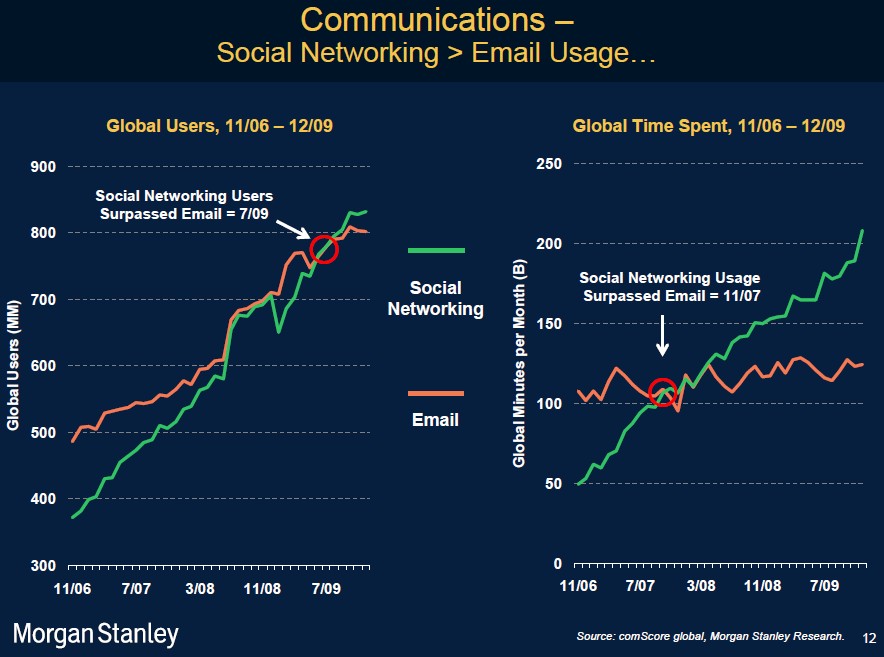
This graph from Morgan Stanley’s 2010 Internet Trends report shows that in July 2009, social media users overtook email users across the globe for the first time and I bet that the gap will have grown significantly by the time their next report is published.

One thing that will keep email figures artificially high is that all of the emergent social media channels use email to drive traffic to their sites. Around 85% of my own private emails are Twitter, LinkedIn or Empire Avenue activity notifications.

By the time I read them I have already seen the details on the sites themselves, which present the information in a far more digestible and accessible way, which is why my private email inbox tends to be my last port of call when I go online every day.

My main activity within my private email account seems to be deleting pages and pages of unread, unwanted and unimportant emails.

What do you think? Do you think email will survive in its current form?

The consumerisation of IT

A long long time ago, I was a young detective constable working for the Metropolitan Police. We used mechanical typewriters in those days and we had a typing pool where you would send up handwritten victim statements, which a week later would return for checking and approval. Any mistakes or corrections would be marked up and returned to the typing pool and a few days later the final version would re-appear ready for inclusion in the case papers.

I wasn’t in a position to change such an inefficient process. But I knew there was a better way, so I just did it. I bought myself a portable electronic typewriter with built-in word processor and I taught myself to touch type. I used to take it with me when I was taking statements from witnesses or victims and I’d write down their accounts and print them off there and then and get them to sign them. It was faster and more legible than writing them by hand. And I’d return to the station with a case ready statement.

A few years later I purchased a Rabbit phone. Mobile phone technology had a long way to go in those days. Mobiles were too expensive and too big and the Met Police were not ready to provide them to staff. So I bought a Rabbit, stuck the base unit on my desk and hey presto had the first hands free phone in the Met (probably). It worked a treat. I could move around the office and speak to people on the phone at the same time. And occasionally I’d take it out with me because I knew where all of the local Rabbit transmitters were so I could make calls while out and about if I needed to.

Hardly revolutionary stuff by today’s standards but actually back then it was far from normal behaviour. I took a fair bit of stick for both investments from colleagues who couldn’t quite get why I’d spend my own hard earned money on buying equipment to use at work. In those days the norm was to accept the equipment and technology supplied by your employer and you just got on with it.

Things have changed.

A recent survey indicates that 95% of employees these days have at least one self-purchased device they use for work. I suspect the iPhone is largely responsible for this change in sentiment. These days it is completely normal to see colleagues carrying their own iPhones, iPads, and HTCs around the office and they think nothing of using them for work purposes if they can.

Despite this willingness to buy and train themselves on their own consumer technologies, according to the same survey around 70% of IT departments persist with traditional models of purchasing standardised technologies, which are often seen as a bit of a compromise by the end users.

At the same time, the explosion of social media channels is changing the way we all communicate. Let’s face it – do you know anyone who does not use at least one or more of the following on a daily basis – Facebook, IM, Linkedin, Twitter, Blackberry Messenger, or YouTube?

I read a lovely quote in CIO Magazine the other day that sums it up for me:

“Imagine how a 2011 college grad reacts when she arrives at her new desk and turns on her PC to discover that it’s running a locked-down version of an operating system that was first released when she was 12.”

Be under no illusion. The consumerisation of IT together with the democratisation of communication is changing the face of the modern workplace.

As Internal Communicators we need to keep right on top of this if we are to add value to our organisations.

Censorship feeds the dirty mind more than the ‘f’ word ever will

Believe it or not there are still companies out there that lack the confidence to allow staff to participate in open conversation through internal forums, blogs or just simple comment functionality on the intranet.

The majority – those that have embraced the joys of Web 2.0 internally (or Intranet 2.0 if you want to be really picky) are reporting plenty of beneficial returns; cross functional collaboration, increased knowledge flow, faster communication, better decision making, more innovation, less duplication of effort, improved allocation of resources – I could go on…

Obviously this has also been my own experience, otherwise I wouldn’t be banging on about it. I have also noticed how user generated comments attached to internal news stories drives more traffic than a catchy headline, a funky picture or a high profile author. And as an intranet manager, footfall and engagement with your content is what it’s all about.

At the same time even some of the most enlightened senior executives harbour fears about the risk of a rogue (or stupid) employee posting commercially sensitive, abusive, disloyal, defamatory or otherwise inappropriate content if left to their own devices. Accompanying this is the perception that moderation and even censorship is the best way to mitigate such risk.

Well I don’t think so.

Nothing puts the brakes on a vibrant online community more than heavy moderation and censorship. Believe me, the comments will just dry up. Not just that, but censorship feeds the dirty mind more than the ‘f’ word ever will. Similarly, if you try and suppress a story which is freely available externally you just fan the flames of gossip, conjecture, fear and discontent.

For me it’s all about trusting staff to act responsibly and professionally. I have managed internal communities with hundreds of contributors discussing thousands of topics, which are not always business related either. Most of them are, but if the occasional bit of frippery and banter creeps in, great. It shows we are all human.

And occasionally when someone pops their head above the parapet and dangerously exposes themselves – good! There’s no hiding from the public display of their idiocy and they deserve what they get when the rest of the community deals with their transgression. As well of course the HR team if it’s that bad.

I have seen time and time again that when you trust staff and empower them to take full responsibility for their words and actions they respond by moderating their own behaviour. Those that don’t and choose to abuse the privilege are arses. They are loose cannons and you don’t really want them around anyway.

It is naive in the extreme to expect you can suppress negative sentiment by banning it. Just because you prevent someone from infecting the rest of the workforce with their cynicism or vitriol by not giving them the tools and channels to use does not mean they are not doing exactly that behind your back. Of course they are – only you never get see or hear about it. There are plenty of other outlets and opportunities for detractors to detract that are wholly outside of the organisation’s control.

Heavy moderation and censorship just shows that you prefer to bury your head in the sand rather than listen to your staff and act on their feedback, and this situation just gives your detractors more to complain about.

Of course there needs to be rules around individual conduct on internal (and external!) message boards and forums. You need a strong policy that actively encourages participation, but within reasonable boundaries. Everyone needs to know that their use of such channels is valued and encouraged, but that where they cross the line and expose the company to legal, reputational or commercial risk, they must know that they face the full force of a robust disciplinary process.

So here is my shopping list for your basic needs:

  • A decent application which is easy to use, looks good and is secure
  • A well written social media policy
  • Integration with Active Directory to enable single sign-on and prevent anonymity
  • Some digitally active early adopters
  • A few senior executives prepared to lead by example
  • Thick skin, coz it won’t all be plain sailing

Have I missed anything?

A Lesson in Customer Service

I have a bit of a thing about customer service. For me it is the be all and end all of business success. Poor customer service can kill a killer product and great customer service can flatter a flat product.

Mr Whiteley

I experienced some sublime customer experience the other day from an unexpected source. You don’t often associate customer service with a school. My eldest daughter’s Business Studies teacher changed all that for me. Last Saturday he demonstrated his unquestionable right to teach Business Studies. Not because he is an excellent teacher or because he has the relevant academic qualifications, but because he gets customer service.

Jessica had a hard week last week. She struggled with a couple of mock Business Studies AS Level exams, despite her teacher’s best endeavours in recent weeks to support her with extra tuition sessions during his lunch breaks. She managed 50% in paper 1 and felt that her performance in paper 2 (which had not yet been marked) was worse. There were tears of disappointment and frustration. Bless her, she tries so hard, but sadly endeavour does not always translate into achievement. With the real exams just two weeks away, we were all resigned to a tough weekend ahead.

And then I bumped into her teacher during an open day at the school on Saturday morning and we got talking. He was very receptive, positive and above all, caring. He said some lovely things about my daughter, in particular about her desire to learn and participate in class.

He had not yet marked the 2nd paper so was unable to comment on Jessica’s specific fears about her poor performance at the time. He showed me a list of older pupils that had faced similar difficulties with the subject at the same stage, who had subsequently gone on to attain the required grades to attend their preferred universities. By the time we had finished I was touched and reassured in equal measure.

When I returned home less than an hour later I found an email from him in my inbox stating that he had just marked the second paper and he wanted us to know that Jessica had done better than expected. He wanted us to know so that the anticipated dark cloud hanging over our weekend could be somewhat lifted.

His actions, before, during and after our chance meeting show me he is a dedicated and very engaged employee. His personal and professional pride makes him a seriously valuable asset to the school. It is precisely behaviour that like this that will attract unsolicited recommendation and advocacy from pupils and parents alike. Not to mention ensuring that his pupils achieve the best they could possibly hope for in their exams.

Mr Whiteley I salute you. I am very grateful for the care, support and encouragement you give our daughter.

Forbidden fruit

Earlier this month an internal memo to all staff from Cisco CEO John Chambers found its way out onto the world wide web. The news wires were fizzing. A glance at the early reports on Reuters, Bloomberg and the Wall Street Journal indicates that a key element of the story was that it comprised forbidden fruit.

This was no corporate press release. This was a leak. Precisely what all Internal Communicators fear most. After all, nothing clips the wings of an Internal Communications team like a leak.

Unless of course it is not a leak – but a press release disguised as one.

I have no idea if this is the case here. But I can’t help feeling all is not quite as it seems. The full text of the memo was published on Cisco’s own blog very quickly after the leak. I have read it several times now and I must confess that without knowing the guy, John Chambers could certainly get a job in a top PR agency if his current CEO gig doesn’t work out.

The language, the structure, the sentiment and above all the lack of clarity around certain key points certainly read like it’s been constructed by someone who knows how to handle a quill and bit of parchment.

It reads like it was intended to pave the way for staff to brace themselves for some tough love, while at the same time demonstrate to the outside world that fundamental change was afoot.

But actually the content was not particularly newsworthy in its own right. There was no announcement of specific product or organisational changes. What made it newsworthy and gave the story legs was the fact that it was a leak.

Had it been a simple press release it would merely have been a space holder – a ‘watch this space’ message that would have been ignored because there was no real substance. But with an internal note stating that:

  • we have disappointed our investors and we have confused our employees;
  • we will take bold steps and we will make tough decisions; and
  • we will address with surgical precision what we need to fix in our portfolio and what we need to better enable,

all of a sudden you have a story.

At the same time you overcome the age old dilemma faced by all public companies – how to keep staff in the loop before you release price sensitive news that fundamentally affects them to the market.

So a week later when Cisco announced details of the closure of its Flip Cam business and 550 redundancies, the market was waiting for the news and the internal audience had already been primed.

I can say without fear of contradiction that in my long and distinguished career in Internal Communications I have never witnessed a deliberate or strategic leak of an internal memo.

Sure, I’ve seen exaggeration on occasion, as witnessed just seconds ago with my use of the words ‘long and distinguished’. I’ve seen stuff leaked to the press accidentally and maliciously. But I’ve never seen an intentional strategic leak of an internal communication.

So was this a strategic or a malicious leak?

You decide.

Are you a giver or a taker?

Nothing has had such a transformative influence on the world of work than email. Forget about the Industrial Revolution – history will show that there was life before email and then there was life after email.

Most knowledge workers today spend their working life living inside their email client and they use it organise and deliver nearly every aspect of their daily work. Many of us will see this as a good thing. After all, everything can be done so much faster these days right?

Hold on just a second.

A recent study in Australia suggests that “The average Australian employee spends less than two-and-a-half days per week actually doing their job. The rest of the time is spent navigating a virtual forest of information”.  The same study found that half of the respondents claimed that on average, only about 50 per cent of their emails were relevant to getting their jobs done.

Information Overload (or Information Rage as the above study calls it) accounts for huge inefficiencies and productivity issues in the workplace. For example, the time spend dealing with spam emails alone costs an estimated $17bn to $21bn in lost productivity every year in the US.

Academics, consultants and assorted subject matter experts offer a variety of solutions. Email free days, email manifestos, formal training sessions and ‘how to’ guides and are some I have stumbled across recently.

My personal favourite – and I like to think I came up with this one – is more campaign based. The campaign would revolve around ones acceptance of individual and personal responsibility for being a net receiver rather than a net sender of email.

You simply have to ensure that every working day you send fewer emails than you receive. What could possibly be easier – and imagine the impact that could have if we all did it?

The most recent public declaration of my personal pledge to the campaign was a month ago here on twitter 😉

Tackling social media

A lot of companies misuse and abuse social media. They know they have to do something. They’ve been to one of those crazy overpriced social media conferences and talked to a few agencies and vendors. They keep reading scary stories about it in the papers. They are exposed to the risk of last mover disadvantage and they know it.

So they jump in to tackle social media with both feet off the ground and their studs showing.  Little wonder their customers show them the red card.

So where did they go wrong?

They invited a bunch of senior bods from the Communications, PR, Advertising and Marketing teams to form a squad.  All good people – top performers and experts in their chosen fields – after all, this is important stuff.

The only problem is none of them were active users of social media.

And so they kicked off by applying tried and tested old world communications values to a medium they didn’t really get. They applied military style planning to detailed and time bound communications campaigns. Not realising that command and control does not work in the world of social media, the downward spiral of selling and spamming began.

All they had to do was leverage the existing expertise and enthusiasm of the growing band of natural born social mediarites already on the payroll. The people who understand that social media is not a broadcast channel but a place where people converse and create meaningful relationships.

They should have listened to self-styled Community Evangelist at LinkedIn, Mario Sundar, who made the following observation two years ago:

“Your employees, starting with your executives, influence your company’s employment brand more than any advertising campaign that you will ever craft. They do so through their blog, word-of-mouth sites like Twitter, and of course on LinkedIn, where they build their “professional brand” in ways that are intrinsically tied to your company’s brand.”

They do this through natural authentic daily interactions with their personal and professional networks. They don’t sell. They don’t spam. They don’t follow orders. You cannot script them. All you need to do is allow them the freedom to express themselves and allow their natural advocacy to shine through.

These are the people who should be involved in formulating and delivering your company’s social media strategy.

Good news and bad news

It’s 9am on Monday morning. The telephone is ringing.

Ring ring. Ring ring. Ring ring.

“Jon Weedon”.

“Hi Jon, its James. Have you got a minute?”

“Sure – what’s up?”

“I see there is a link to the Guardian piece on the intranet this morning. Do you really think we should be encouraging staff to read stuff like that? They’ve clearly got it in for us.”

“I agree it’s not the most flattering of pieces. But is in the Guardian. I don’t think we should ignore it just because it doesn’t share our own view of the industry.”

“I’m not saying we ignore it, I just don’t think we should be encouraging staff to read it.”

“Actually it popped up on Google alerts last night. Lots of staff use Google alerts. I guess a fair few also read the Guardian. One thing is for sure, lots of our customers will be reading this today – on and offline. Surely if our customers are reading it, then our staff should at least be aware of it?”

“Yes but it’s full of factual errors and some outrageously biased opinion.”

“Staff aren’t stupid. Just because they read something in the press doesn’t mean they believe it. One thing is for sure though, if we deliberately filter out the bad news and only provide links to the good news, they will quickly realise that the intranet cannot be trusted as a source of news about the company. That discredits the comms team as well as the exec.”

“Well if staff believe half of what the Guardian wrote today that would definitely discredit us.”

“That’s precisely my point. They are more likely to believe it if they don’t trust our internal communications. They will be very unforgiving if they feel they are being deliberately kept in the dark. We should actually look upon a story like this as an opportunity to create discussion internally and help staff understand what the Guardian journo clearly doesn’t”.

“Actually, that’s not a bad idea. Maybe I should write something in the comment section outlining why I believe the newspaper has got it so wrong.”

“That’s a great idea. Maybe you could get Bob to write a few words from the Legal team’s perspective as well…”

“Steady, let’s not get too carried away. I’ll have a word with him and see what he says.”

“I think that would really be appreciated by staff. Can I take it that you are happy for the Guardian piece to remain on the Intranet then”.

“Um. Yes, I guess so.”

So this is not an actual transcript of a recent conversation I hasten to add!

I merely use this technique to illustrate an issue that I have encountered several times over the years – an issue which I suspect internal comms people and intranet managers everywhere have experienced at least once in every company they have ever worked for. That is, a perception among one or more senior executives that internal communications is just about pushing good news around the company.

Of course we should celebrate success at every opportunity. But we should be big enough and brave enough to acknowledge criticism and even failure.

Because for any internal communication to have value, it must first of all be honest.

The Untouchables

I read a piece on the Seattle Post Intelligencer today that kind of amused me.

The plot revolves around the ‘Seattle Speakeasy Seven’, a gang of wannabe gangsters accused of running an illegal gambling operation in and around Seattle, recently exposed after a 4-year investigation by the city’s vice squad and state gambling officials.

Read the piece and you cannot help but be transported back in time to the 1920’s and the heady days of Prohibition.

Honestly, it could be a scene straight out of Bugsy Malone. For Fat Sam and Knuckles read DK Pan and his trusty sidekick Bill Donnell III. From several delightfully seedy sounding establishments, including a poker room in the now defunct Bit Saloon and a storage facility in ‘Tubs’ (where patrons could previously rent hot tubs by the hour), the wannabe mobsters allegedly ran their dodgy criminal enterprise.

I know this sorry tale revolves around wholly terrestrial activities but I could not help but relate this to the pickle that our North American friends seem to have got themselves into over their somewhat half-hearted ban on online poker.

Have they learned nothing from the Prohibition? In particular the unintended side effect of increasing the grip of criminal gangs who history shows will willingly fill the void created by attempting to ban something that so many of your people do and will continue to do regardless of well intentioned but misguided state intervention.

Never has history better shown that banning stuff that so many of your citizens do anyway is at best futile and at worse dangerous. Don’t ban it – licence it, regulate it, and protect your citizens by pulling the plug on the mobsters.

Allow your citizens the freedom to choose how they spend their leisure time and money. And at the same time stake your claim on all that lost tax revenue that is already out there swilling around just waiting to be put to better use.