Some is not a number and soon is not a time

I’m reading a brilliant book on change management called Switch by Chip and Dan Heath. I’m only 50 pages in but already I know these guys are the voice of reason and I’m going to enjoy the rest of the book. And it was dirt cheap on Amazon!

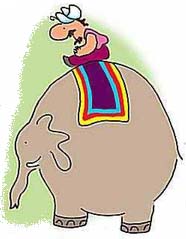
To set the scene they talk a lot about the tension between emotion and logic, referring to a cute analogy of an elephant and its rider, where the heavyweight mammal represents emotion and its rider, who holds the reigns and provides direction, represents reason and logic. Provided the rider has clarity over where to guide the elephant and provided there is something in it for the elephant, the rider should be able to keep the elephant heading in the desired direction. Any disconnect between the rider and the elephant is likely to result in the elephant choosing for itself where to go and what to do. After all, it is far bigger and far more powerful than the rider.

We have all experienced this conflict between emotion and reason. Every time we oversleep, over eat, skip the gym or bark at an inconsiderate driver we are letting our emotional side win over the rational.

It is very easy for the elephant to give in to temptation. It’s not great at short term sacrifice for long term gain and change often fails because the rider cannot keep the elephant on the path long enough to reach the destination. The elephant’s hunger for instant gratification is the opposite of the rider’s strength, which is the ability to think long-term. And the elephant’s strength, which is the enormous energy it can generate through its capacity for love and loyalty can be the opposite of the rider’s weakness. In search of logic and rationale the rider can over analyse and over complicate things and end up driving the elephant around in circles.

Out of this analogy comes a three part framework which the authors believe can guide any situation where you need to change behaviour.

  1. Direct the rider – provide clear direction, because what looks like resistance is often simply a lack of clarity – and remember that “some is not a number and soon is not a time”.
  2. Motivate the elephant – the rider can only get his way through force for so long.
  3. Shape the path – what looks like a people problem is often a situational one and small seemingly insignificant situational changes (“bright spots”) are often the key to unlocking successful change.

I love the stuff about identifying the bright spots and leveraging them. That’s just what Jerry Sternin did in Vietnam to tackle child malnutrition and links in seamlessly with the concept of positive deviance, which I wrote about a couple of weeks ago.

And it was a special treat to see my old chum Richard Pascale get a mention on page 41 😉

Don’t bother me while I’m at work

I had a very interesting chat today with a colleague who objects to the fact that we recently installed poster holders on the back of every toilet door in the building, strategically positioned to catch the attention of anyone seated therein.

He accepts quite happily that when he is out on the lash he expects to see toilet advertising. He’s fine with that; that’s quite legitimate and makes commercial sense. He does not accept however that his employer should use similar tactics to try to grab his attention when he is in a state of temporary captivity and at his most vulnerable, with his trousers wrapped around his ankles.

Just turn up

And he wasn’t getting precious about us intruding on his ‘me time’ in trap two. Investigating his stance further it became clear that he just doesn’t want to be ‘spammed’ when it’s not on his terms. “Don’t bother me while I’m at work” he said, “send me an email so I can delete it if the subject does not interest me”.

The content carried over the last few weeks on ‘Loo Media’ promoted a company donation of £100 to every member of staff to give to a charity of their choice when they sign up for payroll giving, and a reminder that any member of staff who introduces a graduate to the company’s graduate programme would win a bounty of £500 if subsequently selected.

It’s hardly propaganda is it? It’s not like we are trying to ram our core values down his throat.

What struck me most though was the ‘don’t bother me while I’m at work’ line. Would he prefer to be ‘bothered’ when not at work? Of course not.

He seemed oblivious to the fact that ‘bothering’ him while he was at work is precisely what any reasonable employer would seek to do in an effort to make his work experience more fulfilling and rewarding. His attitude was you pay me to do a job, I do my job, that’s it. I don’t ask for you to communicate with me, so you have no right to communicate with me.

What next I wonder. Maybe an opt out clause in every new starter’s contract, giving them the option not to receive any form of internal communication? Perhaps an unsubscribe button on every corporate email? I know – how about a 15 yard exclusion zone preventing any manager from violating his personal space?

I guess it’s just been one of those days…..

Say that again in English

Just 6 weeks ago I blogged about our use of Yammer. Since then another 60 members of staff have signed up and I’m delighted to report that our network is getting busier and busier.

However, the reason why I’m revisiting our Yammer story right now is because today one of our technical team chose to share the following message with us:

“Mockito 1.8.3 is out – http://code.google.com/p/mo… It just added in the ability to auto inject mocks which reduces boilerplate for your dependency injection code. Along with deep stubs, the argument capturing and native BDD support I’d say that it’s currently the best mocking framework for java.”

Now I’ve been working at Betfair for the last 18 months and I know that the company is widely regarded first and foremost as a technology company – and I consider myself reasonably tech savvy.

However when I read the above I first assumed it was some kind of Dilbertesque parody. When I followed the link I continued to believe it was some kind of bizarre technical satire. But the closer I looked, it began to dawn on me that it was genuine – as was the text reproduced above.

Do engineers really talk like this?

If they do then I’m in trouble. I think it may be time to enrol in some evening classes in tech speak – or perhaps Google have a technical translator app?

Harvest and amplify the positive outliers

I’ve was reading up on positive deviance (PD) over the weekend. Whilst the terminology is new to me the sentiment is certainly not and it was really quite exciting to discover someone with far more experience in the field thinking along the same lines as me.

Before continuing though just a word on what I mean by change. Organisational change is situational. It happens when something starts or stops: it could be structural, economic, technological or demographic. I think what most of us mean by organisational change is really transition – the psychological process that accompanies change and invariably extends over a period of time.

Things can and do change quickly, people do not. This is important as change management for me is really all about transition management. It’s about addressing the complex and very challenging people issues rather than the more straightforward situational ones.

With figures almost mirroring the failure rate of mergers & acquisitions, it’s generally accepted that organisational change initiatives fail more often than not. Poor communication is often blamed in both instances, so my own profession can take a bit of a shoeing at such times.

Maybe that is why what Jerry Sternin has to say on the subject resonates with me. His experiences led him to conclude that “the traditional model for social and organizational change doesn’t work, it never has. You can’t bring permanent solutions in from outside”. I know I’m not alone in expressing the following sentiment: all too often change consultants ride into town, offer their wisdom, collect their fees, and then head off into the sunset to refine their models, do a bit more research and write another book. Meanwhile the company reverts to form.

Jerry and Monique Sternin set the PD ball rolling after their work with Save the Children in Vietnam in the 1990’s where they used it to great effect to tackle child malnutrition. The Sternins’ approach was based on the belief that in every community there are individuals whose exceptional behaviours or practices enable them to get better results than their peers using exactly the same resources.

The real challenge is to find a way to ‘infect’ the rest of the community with their behaviours and practices. The Sternins found that such infection took place where new behaviours were encouraged rather than knowledge taught: “Once you find deviant behaviours, don’t tell people about them. It’s not a transfer of knowledge. It’s not about importing best practices from somewhere else. It’s about changing behaviour. You design an intervention that requires and enables people to access and to act on these new premises. You enable people to practice a new behaviour, not to sit in a class learning about it.”

In Vietnam, the Sternins proved that PD worked, and their groundbreaking work has since served as a model for rehabilitating tens of thousands of children in 20 countries, and PD is now being applied around the world to change behaviour in a variety of other social and organisational situations, such as the spread of AIDs in the Third World and ethnic conflicts in Africa.

Here is a list of the steps set out in a Fast Company interview with Jerry Sternin that I have been reading.

  1. Don’t presume that you have the answer – start by listening, not talking.
  2. Don’t assume you need to go cross functional – the aim is not to produce a lively conversation among diverse individuals. Everyone in the group that you want to help change must identify with the others in the group and face the same challenges and rely on the same set of resources to come up with answers. If the group feels that you’re going outside to where things are culturally different, then it becomes another way to impose best practice, and you’re not using PD.
  3. Let them do it themselves – let the group discover, on their own, a better way to do things. Raise questions, but let the group come up with the answers on its own.
  4. Identify conventional wisdom – before you can recognise how the positive deviants stray from conventional wisdom, you first have to understand clearly what the accepted behaviour is.
  5. Identify and analyze the deviants – single out what exactly makes them successful.
  6. Let the deviants adopt deviations on their own – enable people to practice new behaviours, not to sit in class learning about them.
  7. Track results and publicise them – publish the results, show how they were achieved and let other groups develop their own curiosity about them. Celebrate success when you achieve it.  Chip away at conventional wisdom and demonstrate what can be achieved through PD.
  8. Repeat steps 1 to 7 – make the process cyclical. Deviation from the norm can quickly become the norm, at which point the chances are that PDs have discovered new deviations from the new norm.

I really like the sound of this approach.

I’m not going to rush out and start evangelising as I have yet to read any compelling evidence about its success in a hardcore business setting. I suspect every company has positive deviants lurking around somewhere. It could be the sales team that consistently outsells the rest despite making fewer calls. It could be the Finance team that consistently has the lowest churn rate in the company and the highest engagement scores in the annual staff survey. It could be the Help Desk team that always receives the highest number of customer commendations despite being the most under-staffed.

I like the look of PD as it does not make assumptions. This has to be a good thing as change management can be very formulaic and in my book there can never be a one size fits all solution to successful organisational change. Just because a particular approach worked in company A, it does not follow that the same intervention will work in company B.

And instead of focusing on solutions PD seeks to identify underlying successful behaviours already inside an organisation and leverage them.

That sounds pretty powerful to me.
Dilbert and hypocrisy

I noticed this on page 42 of the recent Sunday Times 100 Best Companies to Work For 2010 supplement.

Dilbert.com

It made me chuckle as it reminded me of an incident some time ago when I was asked to create a communications plan for a project that had no apparent project plan.

But now that I’ve shared this with you I’m feeling a bit grubby. I’m feeling guiltier than a blackcurrant knocking back a glass of Ribena – and I’m feeling the need to issue a bit of a disclaimer.

The thing is, I’ve never been a huge Dilbert fan as I think it’s all so depressingly negative. Don’t get me wrong, it can be very funny – if you think about it, lots of humour is depressingly negative.

Dilbert is a passenger. He stands there seemingly powerless to do anything positive or fix anything. All he does is mock the bleeding obvious. I reckon Dilbert fans identify with his frustrations and think that sharing a regular comic strip with their colleagues, apart from being funny, is their contribution to making things better. Actually what they are really doing is copying Dilbert’s impotence and inaction.

I’d wager that the spirit of Dilbert thrives most in organisations where people feel undervalued, ignored and doing meaningless work. If I were conducting cultural due diligence on a company, I’d just walk around the offices and count how many Dilbert strips are hanging off the walls.

That’s why I feel a bit grubby. But I can live with myself as I have at least gone to the effort of explaining my apparent hypocrisy.  And I did subsequently make a positive contribution to the production of the project plan I required on which to hang my comms plan, without taking the piss out of the project manager.

It’s a great day at Zappos how may I help you?

Wow – just did a keyword search on Zappos and realised I haven’t blogged about them yet. How can I possibly expect to be taken seriously as a communications professional if I haven’t even mentioned them before?

Let’s put the record straight. I love Zappos. I love Tony Hsieh. I love their new website. I love their core values. I love their weirdness. I love the fact that Amazon paid $900m for an online shoe shop.

I’d probably love to work there if I was not so utterly in love with Betfair.

Zappos core value number 6 is a thing of beauty: Build Open and Honest Relationships With Communication. Zappos believe that open, honest communication is the best foundation for any relationship. They don’t need to spell out if they mean internal or external communications. For Zappos they are the same thing. Zappos internal communications are conducted in public, in the full view of their customers and their fans.

They acknowledge that communication is always one of the weakest spots in any organization, no matter how good the communication is. That’s why I guess they are so driven towards communicating with their customers and their people so openly and honestly. Because it creates trust and trust is the basis of any relationship, especially an online commercial one.

So if anyone was going to create a TV ad campaign based around real customer and staff interactions, it was going to be Zappos. I really like the results. What a great way to expose your company’s personality!


If you are interested in Zappos, you can follow Tony Hsieh on Twitter – alongside 1.6m other doting fans. I can’t think of many other CEOs who can command such a following.

Actually I can’t think of any – can you?

The soft stuff is the hard bit

I went to a very interesting breakfast ‘roundtable’ this morning, hosted by People in Business (PiB). We were there to talk about Employee Communications During Mergers & Acquisitions and to mark the launch of a book by the same name written by PiB’s Jenny Davenport and Simon Barrow.

There were a few grim faced, hardened old M&A advisors at the table and some of the things they said got me thinking about their trade.

Why is it that M&A advisors are not subject to qualitative measurement around the long term value created by the transactions they advise on?

Seems to me that they are simply measured on the total fees they manage to acquire in any given year. Check out this list of 2009’s top ten M&A advisors to see what I mean. I had a hunt around for a top ten based on long term sustainable value creation and couldn’t find one.

There is plenty of research which suggests that M&A activity fails to create value for the companies involved more often than not. The failure rate of mergers and acquisitions is similar to that of any large corporate change initiatives – around the 70% mark. And in both cases, it is the so called soft stuff that is widely recognised as the root cause of failure. Insufficient attention to the people agenda, clashing cultures and poor communication in particular.

If the M&A advisors know this, why is it that they don’t do something about it – or at least advise their clients to? It’s because their focus is on getting the deal done. Their priority is to sell the financial and operational value of the deal to the analyst community and institutional shareholders. And these guys have a short attention span. They are looking at the share price graph on the day of the announcement. They are not really interested in how well the company will be performing in 5 years time. And the advisors are interested in getting their fee – which is obviously paid upon completion, not incrementally on a long term performance related basis.

The same can be said of executive search and recruitment. How many head hunters are measured on their ability to fit the right person into a senior leadership role in a company on any long term success metrics? How many would be willing to accept that they got it wrong? None of course. It’s a numbers game, and their job is done once the offer has been accepted and their cheque is in the post.

Actually, I believe that the clients get it. Companies are far more likely to instruct external specialists to conduct cultural due diligence than the advisors. PiB said as much today when I asked them how many of their clients came from advisor instructions. The answer was just one out of the 26 significant M&As they have been involved in. In all other instances it was the company or companies involved in the transaction that called them in.

PiB also mentioned that recent research conducted by Brewin Dolphin indicates that these same PiB clients have outperformed the FTSE 100 index by 68% since the relevant transaction.

So why am I banging on about this?

Because I am communications professional and I believe with all my heart that the role we have to play in the day to day running of a business, and in particular at times of major corporate change, what we do or don’t do has a serious impact on company performance.

Internal Communications is all about creating a climate inside an organisation where the major factors that influence employee engagement can thrive: respect, trust, openness and recognition.

We represent the conscience and the consciousness of the company and no-one is better placed to advise and deliver on the hardest bit during times of change – the soft stuff.

Get a grip!

I don’t get it. Why would an intelligent adult go to the time, effort and cost of turning out at Wembley to watch their country play in an international friendly football match and feel compelled to boo John Terry before he has even kicked a ball?

The figures suggest that that 45% of women and 55% of men have been guilty of committing adultery. Given that these are the ones who have admitted to it or have been caught, I’d guess that the real numbers must be even higher.

I’ve had a belly full of ‘holier than thou’ phone-in show callers and journalists banging on about how John Terry has let down his club and country.

Only one person on this earth really knows the extent to which his behaviour is worthy of reproach. Who are we to boo the man when we have no knowledge whatsoever of what really went on. I don’t dispute that he had an affair with a single woman whilst married.

But hang on a minute. So did Bill Clinton. So did Prince Charles. So did John Prescott. And Hugh Grant, Tiger Woods, Jude Law, Gordon Ramsey, Chris Tarrant, and Brad Pitt. Not to mention Sven Goran Eriksson (OK he was not married), Gary Lineker, Ashley Cole and of course David Beckham, who incidentally attracted nothing but cheers as he ran the line warming up last night.

I think you get my drift. 

I’m not condoning adultery. But is it really something that should force England’s captain marvel to step down? 

Get a grip people!

One-legged man on course to win arse-kicking contest

I love Boris. Don’t assume from that I’m a Tory. I love Boris because I warm to politicians with personality and who don’t take themselves too seriously.

Three days ago Boris wrote a piece in the Telegraph in which he took a swipe at an article in the Sunday Times titled “Gordon Brown on course to win election”. This possibly bold assertion was based on the results of a YouGov survey which placed the Blues on 37%, as against 35% for the Reds – the closest gap between the parties in more than two years.

Boris playfully suggested an alternative equally implausible headline could have been “One-legged man on course to win arse-kicking contest” before suggesting that we’d be better off forgetting the polls and keep an eye on the bookies instead. “The reason I trust the punters of Betfair more than I trust a poll in a Sunday paper is that the punters have thought it through with the care of those investing their own money” barked Boris.

This got me thinking about the reason why prediction markets appear to outperform polls. Is an opinion any more valuable when it is expressed through a financial interest in the outcome? I’m not convinced because as all Betfair punters know the margin between a good bet and a bad bet is very slender indeed.

I and many fellow Betfairians often put money on the drop dead favourite not winning the race (or game) as the odds can be very attractive. This is commonly known as laying the leader. It does not mean I believe the favourite won’t win by the end of the race, it simply means fluctuating fortunes (and therefore odds) are likely to present me with opportunities to trade my position profitably before the race finishes.

By the same token, it can therefore often pay to back the one-legged man to win the arse-kicking contest at very long odds because we have seen time after time that the implausible has an alarming albeit occasional propensity to take us by surprise.

Poker is an interesting game. Anyone who plays Texas Hold ‘Em seriously will know that fun money or friendly games just don’t work. In order for poker to work properly the element of risk is required. Without risk it is simply a game of luck and the person with the best cards will win any given hand. I guess this in a way supports the notion that predictions based on a financial stake are more accurate than simply asking someone for an opinion or voting intention.

Anyway, regardless of the merits of prediction markets versus polls, I doubt one can argue against a combination of data from both providing the ‘belt and braces’ solution to predicting the outcome of the forthcoming UK General Election.

And that is exactly what Betfair has done in partnership with leading research agency ComRes when it’s excellent new Election Predict 2010 website launched yesterday.