What motivates you?

I bumped into this very clever video the other day. Actually, one of our engineers posted the link on Yammer – but that’s another story…

It’s a 10 minute presentation by Dan Pink, author of the much acclaimed Drive: The Surprising Truth About What Motivates Us, which contains some really interesting insights drawing on four decades of scientific research on human motivation.

Most experts agree that money is never at the top of the list of factors which motivate people. Dan Pink agrees with this with one notable exception; higher pay equals better performance provided the job being performed involves only mechanical/repetitive tasks. Where work calls for anything beyond this, such as rudimentary cognitive skills, creativity and decision making, larger rewards can actually lead to poorer performance.

Personally I think there is a very simple sociological issue exposed here which does not get discussed. People who perform jobs that are very mechanical and repetitive tend to be less well paid.

Poorly paid people will respond to financial incentives. It’s blindingly simple. They need the money. People who routinely need to exercise their cognitive skills, creativity and make big decisions are by default paid much higher salaries. When you are paid a lot, financial incentives are far less compelling. They don’t need the money quite so much.

He does not exclude money completely as a work place motivator. If you don’t pay enough, people won’t be motivated. Pink’s fundamental premise is that provided you pay enough, and thereby take the issue of money off the table, then autonomy, mastery and purpose become the three main forces for motivation and engagement. I guess this is not inconsistent with Maslow’s Hierarchy of Needs, which most psychologists and sociologists seem to swear by.

The content of the video is very interesting in its own right, but what makes it a truly great find is the very clever and ever so engaging use of animation as an alternative to death by PowerPoint. I think they call it scribing, and a British company called Cognitive Media appear to be pioneering this stuff.

Honestly, it really works. Judging by the number of ‘likes’ and positive comments on the Yammer thread, people really enjoyed the experience. I found the technique quite riveting. Give it a bash; it is 10 minutes well invested if, like me, you are turned on by interesting new ways to communicate.

I was delighted to see Atlassian get a mention as well. Atlassian are right up there with Netflix and Zappos when it comes to promoting the importance of a strong company culture as a differentiator and source of genuine commercial advantage. In this context, Atlassian are held up as an example of the importance of autonomy at work.

Once a quarter, engineers at Atlassian are given 24 hours to work on whatever they want, with whoever they want, however they want. The only ask is at the end of the 24 hours they show the rest of the company what they have been up to. According to Dan Pink, that one day of “pure undiluted autonomy” has led to a whole array of fixes to existing software and a whole array of ideas for new products that otherwise would never have emerged. Instead of paying an innovation bonus, they take the view that “you probably want to do something interesting, let me just get out of your way.”

Google famously do the same with their 20% time and Yahoo call them Hack Days. I like!

No going back

Can you imagine popping into your local bakery to pick up a baguette and after learning that they have sold out you find your exit blocked by a couple of bouncers who refuse to let you leave the shop without making a purchase?

It’s not going to happen.

So why on earth do some websites think that adding a bit of JavaScript to their homepage to prevent you from using your browser’s back button to leave their site is a good idea?

Hell has more chance of freezing over before I will ever intentionally re-visit a website that deliberately thinks that this is a legitimate way to encourage visitors to spend more time with them.

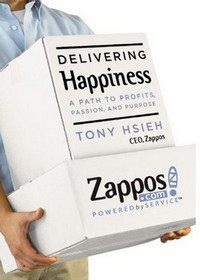
Delivering Happiness

Next week sees the much anticipated publication of Tony Hsieh’s Delivering Happiness. I was fortunate enough to get my hands on a couple of advance copies a few weeks ago on the understanding that I would review the book on Riding the Ripple and give the other copy away to one of my readers. 

It’s a bit like being gifted tickets to Super Bowl on the understanding that I turn up for the game. Why would I not want to write about one of the people on planet earth that I most admire? 

As books go, I’ve read better. But as a real life example of how a very different kind of corporate culture can become the driver of unprecedented commercial success, it really doesn’t get better than this. 

Tony Hsieh is no literary genius; he is just a straight forward, straight talking chap who possesses bucket loads of intellect, emotional intelligence, drive and humility. 

Oh and he happens to be CEO of one of the last decade’s biggest internet sensations, Zappos.

On the face of it, Delivering Happiness is an archetypal story of rags to riches – and as a self confessed Sunday Times ‘How I made it’ addict for donkey’s years, I’ve read hundreds like it.

But actually I haven’t. I have never read anything quite like this before, because Tony Hsieh is a one-off. 

  • How many people do you know who would turn their back on trousering $8m in order to chase a passion?
  • How many CEOs do you know who’s core beliefs on human interaction are heavily influenced by the very tribal behaviour experienced in rave culture?
  • How many companies do you know that prefer to create interesting stories through delivering amazing customer experience instead of paying for PR?
  • How many companies do you know that rely on word of mouth and spend the money that other companies would spend on advertising on customer service?
  • How many companies do you know that communicate with their customers and staff at the same time, over the same channels? 

I will be examining these and other themes in the book over the next few weeks. For now I hope I have whetted your appetite for Delivering Happiness sufficiently that you’d like to take a shot at winning yourself a free copy. 

All you have to do is RT any tweet you see from me mentioning  Delivering Happiness and then DM me and tell me how many posts on Riding the Ripple mention Zappos, and how Tony Hsieh pronounces his surname – is it Shay, Sigh or Shy?

Alternatively you can just buy it on Amazon!

The art of corporate apology

My infatuation with Zappos reached new heights at the weekend. Nailed on to undermine morale, there is nothing worse than working in an environment where the grapevine consistently beats formal and informal communication channels, especially when things go wrong and there is no acknowledgement.

Too many companies operate in a climate of unnecessary secrecy, either in the belief that you can keep a lid on major foul ups (which you can’t) or because they have yet to learn the art of corporate apology. This applies equally to the internal and external audience by the way.

Internally, without acknowledgement there is no learning and the most powerful thing about making a mistake is the shared learning opportunity it presents. Honesty and openness when a clanger is dropped should contribute to that particular clanger not being dropped again. Ignore it – or God forbid try to cover it up and you will be punished. Maybe not immediately, but your time will come.

I’m very blessed to be working for a company that gets this, and whilst it may not quite be up there with Zappos, it’s not far off.

So, back to the incident/communication that prompted this outpouring of love and goodwill.

How does this rate for speed, transparency and humility in the face of a customer pricing mistake that cost the company a $1.6m loss in the space of 6 hours last Friday?

http://blogs.zappos.com/blogs/inside-zappos/2010/05/21/6pm-com-pricing-mistake

It’s beautiful is it not?

Ashes to cashes

I’m not often moved to say anything good about Paddy Power.  Let’s face it, their market on which Premier League player will be burgled next last September was an absolute frickin disgrace.

But they struck PR gold yesterday with the launch of www.volcanobetting.com and I must confess to feeling a tad jealous for not thinking about this before they did. Their so called Cash for Ash initiative is genius. Insurance companies balking at providing cover to travellers against disruption to their holiday due to airport closures caused by Iceland’s erupting Eyjafjallajökull volcano please take note.

Paddy Power is now taking bets on the closure of specific UK airports for at least 1 hour on dates between June 1 and August 31. Travellers can bet at odds of up to 20-1 to hedge against flight delays or cancellations.

At those odds, a £100 bet (or shall we call it insurance premium) will return a not-too-shabby £2,000 if the bet comes in.

I have no idea how popular or busy this market will be – according to them there has been a lot of interest from their customers. I don’t suppose it really matters. If it meets a genuine demand, good for them. If not, their creativity and innovation (in this instance!) has already generated plenty of very positive TV, radio and newspaper coverage.

Good for them!

Thou shalt not greenwash

Reading Dan Gray’s Live Long and Prosper this week re-ignited an intellectual debate that has been raging within my head for ages.

Can you preside over a truly sustainable brand if the focus of your corporate responsibility activity is not directly relevant to your own business strategy and operations?

Dan Gray says no way. His third commandment, “thou shalt not engage in greenwash” states that sustainable brands must integrate and serve those concerns that are directly relevant to their sphere of influence. They must focus their corporate responsibility activities on issues that are directly relevant to and most impacted by the business’ strategy and operations.

I can see the sense in this for most commercial undertakings. Oil companies should clean up after themselves if they make a mess. Chocolate manufacturers need to be careful where they source their palm oil from. Shoe shops don’t want to be buying stock from sweat shops employing 6 year old kids working 12 hour days for two bob. But no one is seriously questioning our right to put petrol in our Prius, a Lion bars in our belly or Twilights on our toes.

But what about tobacco companies? Fundamentally, their core business reduces the life expectancy of every one of their customers. Does this mean that the focus of their corporate responsibility activities has to be on finding a cure for lung cancer and providing medical assistance to those damaged by their products? The logical extension to this argument would be the only way for a tobacco company to create a sustainable brand would be to close down its operations and stop making cigarettes.

I’ve seen many good examples of companies engaging in corporate responsibility activities that are not directly relevant to their own operations that do not comprise greenwashing.  And I have seen many examples of companies who try a little too hard to leverage their community programmes to support their commercial activities, which to my mind is equally as cynical and potentially damaging as washing your greens.

Regardless of my issues with Dan Gray’s third commandment, it was a very insightful read and I’d thoroughly recommend anyone interested in this stuff to grab hold of a copy.

New Brand Tribalism

Kudos to the gang down at New Brand Tribalism (NBT from now on) for doing something startlingly different this week. In this age of instant e-access, 140-bit brevity and virtual buddies, how excited was I to receive an unsolicited package at work the other day. Remember them? Not quite brown paper held together by a piece of hairy string, but a none-the-less equally nostalgia inducing Jiffy bag. I wasn’t expecting anything from Amazon or eBay, so it was with a mounting sense of excitement that I ripped open the package to reveal “Live Long and Prosper: The 55 Minute Guide to Building Sustainable Brands”.

Written by Dan Gray, who as it happens I know through his regular contributions to Commscrum, (one of my favourite ‘serious’ blogs), the blurb promised a quick and deceptively simple guide to why CSR is dead and ‘design for sustainability’ is the next competitive advantage.

To be frank it could have been about bee keeping or beard trimming and I’d still have read it.

Not because it was a freebie – but because I have to return it as soon as I’ve read it. And because it had a library card pocket on the inside front cover complete with library card. It really has been years since I’ve seen one of them! And because the Jiffy Bag contained an SAJ (stamped, addressed Jiffy) so that I could return to sender at zero cost to me and that I would return to sender because it’s not easy to chuck a handful of unused postage stamps in the bin.

But the main reason I was going to read this book come what may was because it was accompanied by a note from my mate Eb at NBT reminding me of one of their core values: Knowledge is Energy. Knowledge Shared – is Energy Shared. What a great way to bring your core values to life. I want to read the book. I want to send it back. I want to share the experience with others.

NBT have invested a not inconsequential sum in sending this (and other books I’d wager) to a number of their friends, clients and countrymen to demonstrate not just a desire to build their own tribe of fans and doting admirers, but an expertise at doing just that.

Baby on board

As a keen student of human behaviour I’m always fascinated by people’s reactions to various stimuli. I’m still perplexed by what I witnessed on the tube from Wimbledon to Earl’s Court this morning. I’m sitting opposite a fairly scruffy 16 year old schoolboy. After tinkering with his iPod for a minute of two he puts it away in his rucksack and pulls out a biology text book and starts reading in earnest.

By Earlsfield, the train is filling up and it’s standing room only. Nose deep in my own book, I nonetheless notice the young man leap up and offer his seat to a woman standing nearby. Her reward to this young impressionable teenager for this act of kindness was an “I’m fine thanks”.

Having committed to giving up his seat he took up position near the starboard doors and watched as his seat remained empty all the way to East Putney. Several standing passengers were eyeing it nervously, but none were prepared to make a move on it.

At East Putney, as the doors opened an elderly man sitting in the seat next to the vacant one left the train, at which point the woman immediately sat down in the newly vacated seat. One of the other passengers duly occupied the boy’s seat. Meanwhile the schoolboy watched on from the sidelines, probably trying to work out why the woman had behaved like this.

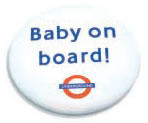
It’s only as she sits down that I notice the badge she is wearing on her coat.

Baby on Board

I don’t get it. She is clearly in the market for blagging a seat, otherwise she wouldn’t be wearing the badge. Why could she not have just rewarded the schoolboy with a smile and a thank-you and taken up occupation of his seat?

Instead her reward for his good manners and act of kindness (which let’s face it you don’t see so often these days from school kids) was a very public brush-off which has probably left the poor chap traumatised for life.

What will you do?

Together for LondonI quite like Transport for London’s current ad campaign, Together for London. It is aimed at passengers and using very simple graphics and clear concise messages, it sets out to get across the message that a little thought from each of us can make a big difference for everyone.

I wonder if they have an internal version of the same campaign?

There’s a train driver on the District Line who for me personifies employee engagement. I have had the pleasure of travelling on his train a few times recently.

Yes, pleasure!

Regulars on London Underground may think this is an odd thing to say. Tube trains are a means to an end – on a good day they get you from A to B. They are not noted for their comfort or hygiene and certainly not for their ability to lift one’s spirits.

Meet District Line Dave. I don’t know his real name, but he sounds like a Dave. Dave does not make customer announcements from the manual. I’m sure he says what he has to say. But it’s what he doesn’t have to say and does that makes Dave my hero. He adds a bit of humour and personality to his work. He doesn’t tell jokes, but he certainly raises passenger morale through a combination of charm and wit.

He tells the odd short story and he shares the odd pearl of wisdom. In doing so he brightens our lives. He connects total strangers who share knowing smiles, some of complete surprise and others of recognition and appreciation. The few times I’ve seen him, as alighting passengers walk past the drivers’ cab at Wimbledon they smile, wave and even queue up to talk to him.

I Googled Dave this evening expecting at least to find a Facebook fan site or something. All I found was a very recent piece in the Telegraph and an unnecessarily long video on YouTube. And still no clue to Dave’s real identity.

If I ever find myself on one of his trains again I promise I will make the effort to say hi and to thank him for being an example to us all of how bringing a bit more of yourself to work can brighten up the lives of those around us.

If anyone from TFL is listening, please give Dave a bit pat on the back. He is one of your greatest ambassadors!

Brown’s big toed blunder

The world’s gone barking mad again.

When I woke up this morning, Labour were at odds of 30 to 1 to achieve an overall majority on 6 May. I know this because I work for the world’s biggest and best betting exchange, and our customers are getting more active by the day in the run up to the General Election on our UK election markets.

I spent the morning at a Social Media in a Corporate Context conference and being a good boy had declined the rather sensible invitation of my hosts to cast aside traditional conference etiquette and keep my mobile phone switched on throughout the event.

So imagine my surprise when during the lunch break I reconnected with the outside world to discover that the odds on a Labour majority had drifted out to 46 to 1.

Blimey I thought – something big must have happened to cause a swing of this size. The Labour party had fallen to its lowest level of support in the betting since the market opened two years ago.

The newswires were fizzing and Twitter was full of it. Gordon Brown had insulted a lifelong Labour supporter in a private conversation in the back of his car.

It strikes me that what he says in the privacy of his own car is his matter. The fact that his comments were picked up by the media because the microphone on his tie had not been switched off was unfortunate. But hey – hands up anyone who has never said a bad word about someone moments after smiling sweetly in an effort to avoid unnecessary conflict.

Have you never maintained an air of conviviality with someone you may not see eye to eye with and once you’ve put the phone down said a few choice words to relieve your frustration?

I see absolutely no crime here. What I see is a gleeful over-reaction from an over intrusive and mischievous media, on a mission to make something out of nothing.

That’s my first point.

My second is why the sensitivity over someone’s big toes?  I just don’t get it!