Baby steps not big leaps

Baby stepsI spend a fair bit of time studying behaviour change. After all, as an Internal Communications specialist that’s what it’s all about. When you are in broadcast mode the whole point of communicating is to create or contribute to some effect on behaviour.

We don’t just talk because we like the sound of our own voice. We talk to make people feel better. We talk to make people understand things. We talk to influence people and we talk to prompt people into action. We talk because we want people to tell us what they think. 

There should always be an objective when we talk. So to be a good Internal Communicator we need to fully understand the effect our broadcast communications have on those they are aimed at.

I often come across tips, lists and guidance on good practice in behaviour (and/or culture) change and always find myself agreeing with some of it and disagreeing with some of it. Everyone has their own views based on their own learnings and experience.

Rarely have I bumped into such sound advice as this. It’s only 10 slides but each one is a gem. My thanks go to Stanford University’s beautifully monikered Persuasive Tech Lab for sharing!

I chose to name this piece Baby steps not big leaps as this rule in particular represents for me the most important of all of the 10 commandments of successful change.  Thou shalt seek small incremental successes.

It’s why I named this blog Riding the Ripple and not Surfing the Tsunami

Pub quiz on poker

Let’s start off with a little poll.  Please play along.

I’m going to stick my neck on the line here and suggest the pub quiz box is likely to be the clear winner.

Needless to say, always the contrarian, poker gets my vote. If you read my last post on this you’d already know that I consider poker to be a game of skill and therefore not really gambling. 

The biggest common denominator in all but one of the above options is that your investment (or stake) relies wholly on the performance of other people.  Except of course, poker.  Does this fact alone not distinguish poker from other forms gambling?  The way I see it, for poker to qualify as gambling you’d need to be betting on the outcome of a poker tournament – not actually taking part in one.

When you play poker for money you invest in your own ability.  It is your experience, knowledge and ability that will determine how well you do.  As I pointed out in my earlier piece on this, 75% of all poker hands win without any cards being shown.  By definition this means that 75% of the time what makes you a winner is not what cards you have been dealt, but how you play them.

I went to a quiz night at my daughter’s school a few weeks ago.  I remember one question in the music round was to identify the nationality of the mighty rock band Midnight Oil.  I knew the answer because I saw them perform live in a pub in Sydney during my gap year in 1979.  No one else on the team had a clue, so I guess we were lucky right?

Does that mean a pub quiz is a game of chance or a game of skill?  It’s a game of skill of course.  The winning team will usually be the most knowledgeable.  Just watch an episode of Eggheads if you doubt my wisdom on this.  Sure, occasionally skill, experience, and knowledge will be overcome by a bit of good fortune.  But generally speaking, in a pub quiz the strongest team will prevail.

Likewise with poker, the stronger players will generally progress further in tournaments than the weaker ones.  That’s why the same faces appear so regularly on main event final tables.

So what is the fundamental difference between a pub quiz and a game of poker?  And why is one classed as gambling and the other not?

Buggered if I know…

It’s all a matter of degree

How often you see a requirement to be educated to degree level in Internal Communications recruitment ads? More often than not I’d wager.

Even for an entry level role there seems to be a belief in some quarters that a degree is a must. There is an assumption that a graduate will have the necessary intellectual capacity to cope with the demands of a complicated industry. There is an assumption that a graduate will have a proven ability to write well and work under pressure.

Well not here it ain’t. Business acumen gives you credibility. A sparkle in your eye helps engage an audience. A strong work ethic helps you meet deadlines. Fire in your belly lights up a room full of jaded executives. A sense of humour disarms a potential foe. I could go on but I think you can see where I’m going with this.

Going to university is no guarantee of any of these prized characteristics – and I’d place all of them above the need to see a relatively meaningless piece of paper.

Paper sifting any candidate for an Internal Communications role because they do not have a degree is nothing more than a sign of lazy recruitment and it reflects badly on the hiring company.

Anyone care to disagree?

Taking the piss out of Social Media

Through the medium of piss, the essence of each Social Media website listed below has been captured concisely and with varying degrees of accuracy.

The list was inspired by numerous tweets doing the rounds over the last few days, none of which ventured beyond LinkedIn.

I guess it was quite funny up to that point and then I had to go and spoil it.

Mind you, I am quite proud of the Wikileaks entry!

Have I missed any?

Twitter: I need to pee.
Facebook: I peed!
Foursquare: I’m peeing here.
Quora: Why am I peeing?
Youtube: Watch this pee!
LinkedIn: I pee extremely well.
MySpace: Peeeee, maybe the face I can’t forget…
iTunes: Download the single for just 79p.
Bebo: Mummy I need a pee pee…
Urbanspoon: The pea soup was to die for.
Wikipedia: I just passed a liquid by-product of my body, which was secreted by my kidneys through a process called urination and excreted through my urethral passage.
Wikileaks:

Google+

I just peed my pants…

Let’s all pee in a circle!


Asda’s Green Room re-visited

This time last year I scribbled down a few thoughts on Asda’s Green Room, a website where Asda staff can get together to find out what’s happening around the company as well as share their own stories, pictures and videos.

What makes the Green Room so special is that whilst most companies do this kind of thing, very few do so in public. There’s no hiding behind the corporate firewall here.  Customers, shareholders, media, rivals – in fact anyone with a passing interest in Asda can visit the site and have their say.

So when I heard that the Green Room had a makeover last week I rushed back to pay a visit – and I must say it looks amazing.

The new homepage is very easy on the eye and packed with attractive hooks to draw you deeper into some great content.  Additional functionality has been added to make it easier to submit comments, upload and preview pictures, and receive progress information on both.

New design elements have enhanced navigation around the site as well as point you to other linked resources like the Green Room’s Facebook page and Twitter feed. I really really like what they have done.

I said some pretty negative things last time round about my disappointment at the lack of obvious staff interaction with the site. I’m pleased to say things have improved on that front.

There was a lovely news piece from early December where Asda President and CEO Andy Clarke thanked staff for their Herculean efforts in keeping the business going during the extreme weather conditions, in short informal video. This in turn attracted a bunch of comments from staff and customers, telling their own stories of braving the Arctic conditions.

If I were to be really picky (which obviously I am!) I’d have loved to have seen a follow-up comment from Andy Clarke in the thread acknowledging the stories, in particular the comment from an Asda customer who explains why the residents of Slack Head in Beetham are “very lucky to have one of your employees in our community”. This kind of content is priceless. But only if people are reading it.

There is still a lot of work to be done to make the Green Room the runaway success it deserves to be. Despite improvements, levels of engagement with staff are still patchy. Most of the news stories don’t seem to attract comments, including one where the company announced it had raised £4m last year for partner charity Tickled Pink. Another story about a member of staff who had just won £5.6m on the National Lottery attracted a single solitary comment.

The same lack of engagement is reflected on Facebook, where since the beginning of December, the 30-odd posts on the Green Room wall have attracted just 4 comments.

The next step for the Green Room team has to be off-line.

The on-line offering is more than fit for purpose. It is actually bloody good. What is needed now is awareness, education, and encouragement.  Staff need to be encouraged and empowered to get involved. The easy bit has been done – the hard bit starts now.

The key to success in my opinion will be getting the entire management community to lead by example. They need to demonstrate through their own actions that engaging with the Green Room is not just permitted, but genuinely encouraged.

Turds floating on the sea of life

I got up extra early this morning to get into the office and get a few hours under my belt before belting up North for a funeral.

I never made it into work because some troubled soul decided to bring the West End to its knees by breaking into a shop on Regent Street and when the Old Bill turned up he threatening to blow himself up with what turned out to be a tube of Smarties.  

After several hours of tense stand-off and negotiations the man was nicked. Some eight hours later the last of the police cordons was finally lifted and normality returned to London’s West End. If such a condition exists in London’s West End…

Yep – hundreds, possibly thousands of people never made it to work today because of a lunatic wielding a tube of brightly coloured sugar coated chocolate drops.

Meanwhile I had been to the funeral of TJ.

Four years my junior, TJ was tragically taken from us last month by a sudden and fatal heart condition while travelling in the South Pacific. He was fitter and leaner than every one of his old colleagues and friends who turned up to say farewell today. By rights he should have lived for another 30 years and continue to brighten the lives of those lucky enough to know him.

I then spent 3 hours trying to get back into London because some other troubled soul decided to jump in front of a train in Slough, causing the usual network chaos that accompanies such behaviour.

One life taken far too early from a man that really valued it, versus thousands of lives inconvenienced by the actions of a man who clearly didn’t and another who clearly doesn’t. It just doesn’t seem fair.

Today was a crazy day. It was one of those days where the frailty of the human condition exposed itself in all its glory.

New channel for Internal Communications?

How many of you know what a QR code is?

For the uninitiated, it is a two-dimensional matrix barcode that seems a bit smarter than your average common-or-garden barcode.

QR stands for quick response. Toyota invented them in 1994 and they were initially used for tracking vehicle parts during the manufacturing process.

Nowadays they are becoming more common in a commercial content, where mobile phone users are targeted with adverts in magazines, in shop windows and on billboards. I never noticed them myself, but Waitrose took to sticking QR codes on their recent TV ads.  You’d have to be pretty quick off the mark to catch them – although I suppose you could always Sky+ them.

QR codes can be used to display information to a user’s mobile phone, including simple text, to point to a website, to compose an email or text message and even to add a vCard to the device.

Many camera phones, including any with an Android OS and Nokia’s Symbian OS can read QR codes automatically.  I had to download a free app for my iPhone to have a play – but let’s face it, that’s no hardship.

There are several free and easy QR code generators on-line that within seconds allow you to create a QR code, which could then be published online or in print, or perhaps on signage – or maybe your business card.  What about clothing? I found one website that offers customised clothing with your own ‘secret’ messages printed in the form of a QR codes.

Brilliant – it means you can wear really offensive T-shirts in public without embarrassment as only those who choose to point their mobile phone at you can find out what the hidden message is. Try the very inoffensive looking QR code over to the right for size.

The less offensive example at the top of this page automatically directs the reader to this blog.

Do the same with the code to the left of this paragraph and you will automatically be offered the option with a single click to ring me. 

Don’t worry, I like to live dangerously.

Given the increasing use of QR codes in a commercial (and therefore communications) perspective I’ve been thinking about whether or not they could possibly be used in an Internal Communications context.

And you know what? I’m beginning to think they could!

Bad luck?

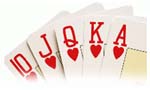
Is poker gambling or not? It’s a debate that has been raging ever since the Americans passed the UIGEA (Unlawful Internet Gaming Enforcement Act) in 2006, forcing some of the biggest operators in the online Poker industry to stop accepting players from the US, including PartyGamingSportingBet, 888 and bwin.

As public companies their appetite for risk was clearly tempered by their long-term fiduciary duty to their shareholders and I guess they had no choice but to withdraw from the American market despite the catastrophic short-term effect on their share prices.

Here’s what I think. Lumping poker into the scope of the UIGEA is harsh because I don’t consider poker to be a form of gambling. Bingo is proper gambling. Scratch cards and lottery tickets are proper gambling. Slot machines, roulette and other casino games – proper gambling. It doesn’t matter how experienced you are, chance is the only determinant.

The Oxford English Dictionary simply defines ‘gambling’ as “playing games of chance for money”.

To the uninitiated it’s easy to see why you may think poker is a game of chance. The best cards will always win and you cannot control which cards you are dealt right?

Wrong. OK, it’s true that the best cards at the end of any given round will always win. However, in online poker over 75% of hands don’t end in a showdown, so the cards you are dealt are largely irrelevant, because over 75% of the time no-one gets to see them.

What counts in poker is not what cards the dealer gives you, but what you do with them. The quality of the decisions you make based on your table position, the size of your chip stack, the betting behaviour of those around you, your ability to read ‘tells’ accurately, your understanding and application of pot odds – all will play a much more important role in your success than the cards you are dealt.

There is a massive market for poker books, periodicals and instructional websites. None focus on luck as being an important component in your poker game play. And come to think of it, I don’t recall seeing a huge selection of bingo or lottery winning strategy books in my local library.

As a keen amateur player myself, I find luck does creep in, but more bad luck than good luck. If you play the game well every time you go into a showdown you should hold the strongest hand. If you then get beaten, that is bad luck. However, mathematically you have played correctly and in the long term you will win more than you lose in that situation. If you go into a showdown with the weakest hand and you win, you have played badly and got lucky – and mathematically in the long term you will lose more than you win in that situation.

Respected journalist, author and poker ninja Victoria Coren knows her stuff. In her excellent For Richer For Poorer: A love affair with Poker she dismisses Roulette as a mug’s game: “Thank God, my old roulette habit has been channelled into poker, which offers the same adrenaline but can, slowly and gradually if I study the game, be controlled by skill and judgement”.

Charles Nesson, a Harvard law professor and founder of The Global Poker Strategic Thinking Society, takes a similar albeit less instinctive view. Nesson sees in poker “a language for thinking about and an environment for experiencing the dynamics of strategy in dispute resolution”.

Garry Kasparov, a chess grandmaster, argues that poker offers lessons on chance and risk management that even his own beloved game can’t. Many chess professionals are moving into poker, not least because the money is better.

I don’t think many right minded person would consider chess to be a game of chance.

Earlier this year a Dutch Court ruled that poker is a game of skill not chance and there is an interesting case currently being deliberated on by the South Carolina Supreme Court, the outcome of which will be interesting.

Above all, there is one very simple, glaringly obvious fact that proves beyond all reasonable doubt in my simple mind that poker has to be a game of skill.

Just take a look at the World Series of Poker (WSOP) Hall of Fame. The top three players, who have all won more than 10 WSOP bracelets over careers spanning 20 years, have accumulated poker winnings in excess of $13m having cashed on over 150 occasions.

Nobody can possibly get lucky that many times! It’s as ridiculous as claiming that golf is a game of chance and Tiger Woods just got lucky.

What I cannot quite get my head around is why anyone, most of all the law makers of the world’s greatest superpower would consider poker to be a game of chance?

Have they never played the game?

Employee engagement in pictures

I found another picture that says it all.

This time, it’s not the person whose job it was to paint a white line at the side of the road who skirted around the fallen branch – this time it the person whose job it was to paint the double yellow lines down the centre of the road!

This is clearly the work of an engaged employee:

Why? Simply because the picture below is clearly the work of a somewhat less than engaged employee!

When is a Blackberry not a Blackberry?

I’m no longer on the cusp of leaving my current mobile phone provider. I’m feeling much better than yesterday thank you very much. Two things have helped.

One is simply the cathartic effect of writing.

The other is the reaction the ‘deliberately provocative tweets’ I published as promised. It only took two tweets. The first one was too late at night to be picked up.

The second one did better.

First to react was T-Mobile.

Swiftly followed by Vodafone.

I responded to both, which prompted the following responses.

These interactions helped. They did not solve anything as I had to do that myself. But they did take away my anger and went some way to restoring my faith in humanity (or something like that). Not sure what happened to O2; they either missed my cry for help or decided not to play.

It matters not. I’m no longer on the cusp of leaving my current mobile phone provider.

And in the unlikely event that I do in the near future, it will be Vodafone that get the call.